Advisor's Opinion on Situation Report No. 2, 2016
An English translation of the Czech original, made with AI. The Czech text remains the record of what was written: Stanovisko poradce k 2. situační zprávě 2016. The CNB published only the Czech text; this translation was made for this archive. The document is the advisor's opinion in full; unlike the later years it carries no separate financial stability part. The text and the two charts are both taken from the hosted PDF. Numbered footnotes are collected at the end.
OPINION ON SITUATION REPORT NO. 2[1]
1. Recommendation
Since the forecast was presented in Situation Report No. 1, a number of anti-inflationary influences have accumulated (lower observed inflation, including core inflation, lower GDP growth, lower outlooks for these variables in the euro area). Situation Report No. 2 presents an updated scenario of the forecast, in which the outlooks for all the key variables are accordingly shifted lower. I agree with the general message of the Report, although before reading it I had intuitively expected the downward revision of the inflation outlook to be even more pronounced. Even so, forecasted monetary policy-relevant inflation at the monetary policy horizon is clearly below the target (1.3% to 1.8%). It would be a little lower still if it were not already starting to be affected by the higher outlook for the price of oil, driven primarily by the discussion of production cuts, which represents a supply shock. Under normal circumstances I would therefore recommend at least one cut in the repo rate. The need to ease monetary conditions, however, is not so great as to make it necessary now to risk the side effects of negative rates or to move the level of the exchange rate commitment. Further postponing the date of the exit does not strike me, in the current situation, as an effective way of easing monetary conditions. So I am left to recommend keeping rates, the level of the exchange rate commitment, and the earliest possible date for ending the commitment at their current values.
In the rest of this opinion I turn to considerations connected with the exit from the exchange rate commitment. It now seems unlikely to me that, without additional measures, it will be possible to abandon the commitment in mid-2017. When the interventions were launched, the plan was that the exit would come amid a pronounced overshooting of the target (up to 3%), which would guarantee that the exchange rate commitment would not have to be renewed soon after the exit. At present, by contrast, we observe an undershooting of the target at the forecast horizon. True, what matters more than the current overshooting at the moment of the exit is the expectation, at the moment of the exit, of future overshooting under the assumption that the exit were not to take place (owing to the lag in monetary policy transmission, which is, however, shorter in the case of the exchange rate channel, perhaps only half a year). Even so, the expectation of a “pressurized inflationary pressure cooker” in mid-2017 may to a large extent rest on the assumption of a noticeable rise in the shadow EURIBOR in that year, of which I am not convinced (see my second specific comment on the Report). At the same time, I consider an exit in mid-2017 desirable, since in the current regime we are unable to smooth the economy's development finely, which my recommendation in the first paragraph also reflects. Postponing the exit is thus a cost in itself, since it delays the return to using a finer instrument.
I believe there are two options for raising the probability of an exit in the middle of next year. The first is to ease monetary conditions this year, either by moving the level of the exchange rate commitment or by using the “Swedish” or “Danish” scenario of negative rates. In section 2 of this opinion I estimate the counterfactual effect of the existing exchange rate commitment on GDP and unemployment; my estimates are consistent with the CNB's communication so far and show a relatively strong positive effect of the interventions (estimates of the direct effect on inflation obtained by this method were already presented in the opinion on Situation Report No. 8, 2015). The available evidence thus supports the view that the exchange rate commitment is a suitable instrument for stimulating the economy and raising inflation. So although moving the level of the commitment could supply the desired expectation of target overshooting at the time of the exit, I do not consider it a suitable instrument for hastening the end of the commitment, since after an exit from a weaker level there could be pressure for faster appreciation of the koruna. For example, according to the forecast from Box 2 presented in Situation Report No. 5, 2015, the upper edge of the band for the equilibrium nominal exchange rate in the second half of 2017 is roughly CZK 26 to the euro.
In section 3 I discuss the international experience with the use of negative rates and its implications for the Czech Republic. I consider the Swedish scenario, in which all bank reserves bear a negative rate, unsuitable mainly because of its strong impact on financial stability. The Danish scenario comes into consideration; in it, enough reserves are exempted from the negative rate for commercial banks to be able to keep non-negative rates on household deposits without bank margins shrinking. Introducing such a measure presupposes that we broadly believe in the effectiveness of negative rates working through the standard channels of monetary policy, and it would therefore make sense at least a year before the planned exit. I argue, however, that not even the Danish scenario is very suitable for us in the current situation, owing to the larger liquidity surplus and the greater use of cash in the Czech Republic.
The second basic way of raising the probability of an exit in the middle of next year is, instead of easing monetary conditions, to introduce a supporting measure that would limit potential appreciation of the koruna after the exit: this I call the “Japanese scenario” of negative rates. It assumes that negative rates work mainly through the exchange rate channel. All existing reserves are exempt from negative remuneration; negative rates would apply only to new reserves (effectively to speculative capital from abroad). Such a measure would best be introduced at the latest half a year before the planned exit; I do not recommend introducing it simultaneously with the exit, because that would raise general uncertainty immediately after the commitment is abandoned. At the end of section 3 I also discuss how most of the legislative problems associated with a Japanese-type negative rate can be avoided. Since this would be a measure that does not much affect domestic entities, it would be appropriate to set the rate low enough to deter short-term speculators (at least enough to offset the interest rate differential against the euro area). In section 4 I take up the effective lower bound on rates for the Czech Republic, which in my view lies in the interval (−2%, −1%).
2. Effects of the exchange rate commitment on the real economy
The effect of the exchange rate commitment cannot be estimated by classical regression analysis, because for that we would need a larger number of central banks that had resorted to such a step in a similar situation. It is more sensible to compare developments before the start of the interventions and during them between the Czech Republic and countries that are otherwise similar to it (e.g. Slovakia). Such a qualitative approach, however, does not allow us to estimate the effect of the commitment exactly, nor does it give us any information about the precision of the estimate. A compromise between the two approaches is the synthetic control method, which has come into use in recent years in political science (e.g. Abadie et al., 2015: the economic costs of German reunification). The aim is to construct a hypothetical (counterfactual) path of the Czech economy in the absence of the exchange rate commitment. To that end, we first estimate what weighted average of variables and countries best captures the Czech Republic's economic development in the pre-intervention period. The difference between the actually observed development of the economy and the hypothetical path, based on the weighted average of developments in the economies of countries that did not apply an exchange rate commitment, represents the effect of the interventions. Jan Bruha already used this method in the opinion on Situation Report No. 8, 2015 to calculate the effect of the exchange rate commitment on inflation, which comes to about 2 percentage points. Here I focus on real variables and use data from the beginning of 2005 to the end of 2015.
In Chart 1 we observe that the hypothetical path of GDP growth without the interventions (the dashed line) would have run below the actually observed value during the exchange rate commitment, with the gap widening over time. In 2014 the effect is not yet statistically significant, but for 2015 we can already rule out with 95% confidence that it is a random deviation.[2] The estimated contribution of the exchange rate commitment for 2015 reaches almost 2 percentage points. This effect will be overstated if the Czech Republic was drawing down its remaining European funds more intensively than the surrounding countries. On the other hand, it is apparent that in the period at the start of the interventions observed GDP growth is lower than would correspond to developments in the surrounding countries, perhaps because fiscal policy in the Czech Republic had previously been exceptionally restrictive, or because the country was already approaching a deflationary spiral (nominal wages stopped growing in 2013). In addition, the hypothetical GDP path is constructed mostly from the developments of euro area countries, whose economies were supported by the ECB's unconventional monetary policy. All of this may, on the contrary, understate the estimated effect of the exchange rate commitment.
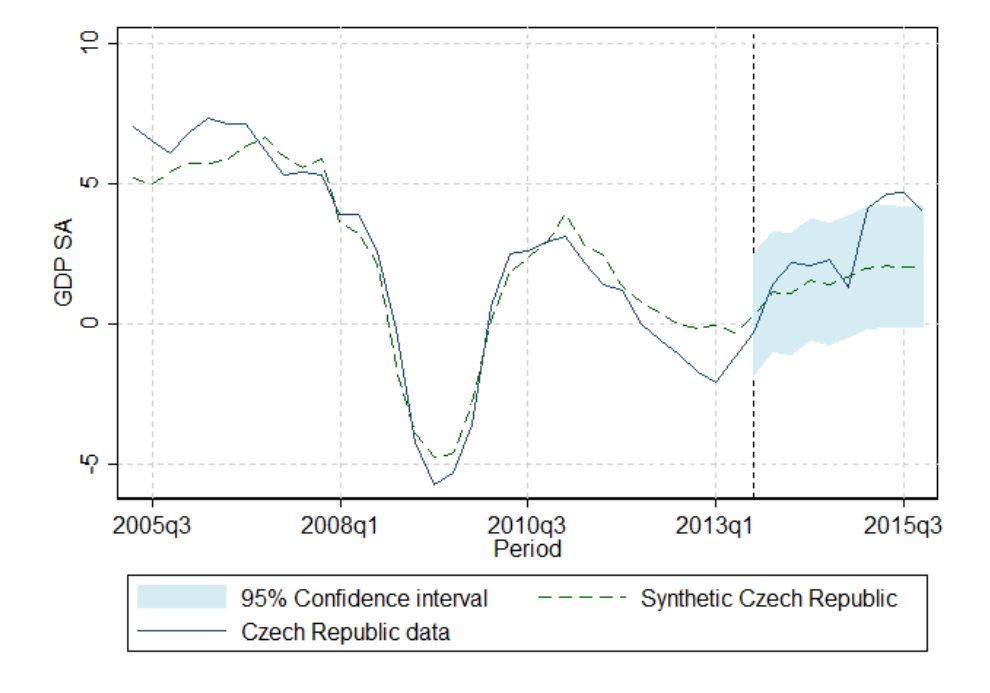
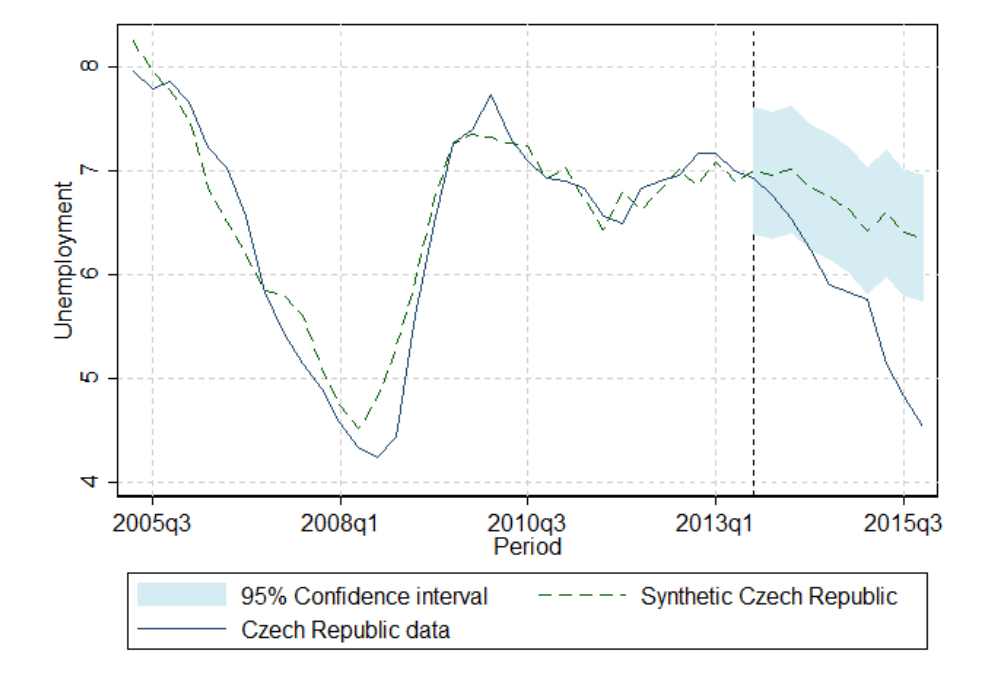
The effect of the exchange rate commitment can be seen better in the general unemployment rate (Chart 2), which is less affected by one-off factors such as changes in excise taxes. Had the koruna not been weakened, unemployment would have fallen in 2014 and 2015, but much more gradually: at the end of last year the gap already reached almost two percentage points, or about 100 thousand jobs. In the pre-intervention period, meanwhile, hypothetical unemployment (the weighted average of the other countries) captures actual unemployment very well. We can therefore rule out that this is a random deviation. It is evident that, alongside its direct impact on import prices, the exchange rate commitment has a robust but delayed effect on the real economy, and through pressure for wage growth it thus gradually contributes to rising core inflation.
3. Experience with negative rates
Seven central banks currently apply a negative rate to one of their policy rates, in the following economies: Hungary, Japan, Norway, Switzerland, Sweden, the euro area, and Denmark. I will discuss their experience in this order (that is, I start with the central banks that began using negative rates recently and whose approach should thus already take into account the experience of the other banks). I also use the results of a recent Bloomberg (2016) survey in which 63 economists from around the world assess whether negative rates in a given country help the central bank fulfill its mandate effectively. I then discuss the implications of the international experience for the Czech Republic.
Hungary. The Magyar Nemzeti Bank cut its deposit rate into negative territory (−0.05%) with effect from March 23, 2016. This measure accompanied a cut in the three-month base rate, which nevertheless remains well above zero. The central bank did not comment on the introduction of the negative deposit rate in any detail, but the measure may be related to the expected decline in liquidity in the Hungarian interbank market in the coming months. The negative deposit rate is expected to encourage commercial banks to lend more to one another instead of depositing reserves with the central bank.
Japan. The Bank of Japan decided to introduce negative rates in January 2016, with the measure taking effect in mid-February. The negative rate (now −0.1%) applies only to additional voluntary reserves deposited with the central bank; existing reserves bear a positive rate (0.1%), and required reserves are subject to a zero rate. The reason for this measure is concern about bank profitability: thanks to the three-tier system of reserve remuneration, commercial banks will be able, without much difficulty, to offer non-negative rates on household deposit accounts without bank margins being hit significantly. If the negative rate applied to all reserves, there would be a threat of increased substitution from electronic money to cash, among other reasons because cash is still heavily used in Japan and (unlike in most other countries that have introduced negative rates) many shops do not accept payment cards.
An interesting aspect of the introduction of negative rates in Japan is the fee the central bank sets for commercial banks on cumulative net withdrawals of cash. If a given bank's cash holdings increase “significantly”, the corresponding amount will be deducted from the reserves that bear a non-negative rate (Bank of Japan, 2016). This system is not clearly specified, and perhaps it is merely “bluffing” on the part of the Bank of Japan to preemptively deter large cash withdrawals. In any case, the intention is for banks to perceive holding cash as at least as costly as holding electronic yen. Although it is still early to assess the impact of the introduction of negative rates in Japan, anecdotal evidence suggests some growth in the demand for cash: sales of home safes have doubled compared with the same period last year (Hongo and Inada, 2016). One reason may be the Bank of Japan's less than clear communication about negative rates, which creates uncertainty among households. In the Bloomberg (2016) survey, 73% of the economists polled are skeptical about the effectiveness of negative rates in Japan. These economists also estimate that the monetary policy rate in Japan will fall further, to −0.3%; on top of that, Governor Kuroda recently declared that he can imagine a rate of −0.5%.
Norway. The Norges Bank does not tend to appear in lists of central banks using negative rates, although its system is to some extent similar to the one used by the Bank of Japan: reserves at the central bank bear positive interest up to a certain limit; beyond that limit a negative rate (−0.5%) is applied. This measure was introduced in September 2015, and the motive was to encourage banks to lend more to one another and not leave excess reserves in their account at the central bank (Norges Bank, 2015). That intention was largely fulfilled, as the volume of reserves above the limit fell by two thirds after the introduction of negative rates. Commercial banks themselves also report that they now try hard to avoid depositing excess reserves with the Norges Bank; interest rates in the interbank market remain positive. The Bloomberg (2016) survey did not assess the effectiveness of negative rates in Norway.
Switzerland. The Swiss National Bank introduced negative rates at the end of 2014, primarily in an effort to damp appreciation pressure on the franc. The main monetary policy rate in Switzerland is currently −0.75%. These deeply negative rates passed through without much trouble into money market and capital market interest rates, and there was no marked increase in the demand for cash. Some market participants, however, are attempting to avoid negative rates and substitute cash for electronic money. For example, one pension fund attempted to convert its assets into cash in order to save 25,000 francs on 10 million francs deposited, even after counting the costs of storing and transporting the banknotes (Jackson, 2015). Negative rates are not passed on to household accounts in Switzerland, helped, as in Japan, by a multi-tier system of reserve remuneration: part of the commercial banks' reserves held at the central bank is not exposed to negative rates. This share, however, is much smaller than in Japan, so there is pressure on banks' profit margins. Mortgage loan rates paradoxically rose after the introduction of negative rates as banks tried to preserve their margins. According to the Bloomberg (2016) survey, though, 70% of the economists polled rate the negative interest rate policy in Switzerland positively. The same survey expects one more cut in the main rate, to −1%.
Sweden. The Riksbank briefly experimented with a mildly negative deposit rate as early as 2009 and 2010. After almost four years of positive rates, the deposit rate was cut below zero again in September 2014. At the beginning of 2015 the main monetary policy rate was pushed below zero as well; it now stands at −0.5% (the deposit rate is as low as −1.25%). As in the Swiss case, transmission into financial market interest rates was relatively problem-free. Legislative problems did appear, for example when, because of negative rates, the holder of a floating-rate bond had to pay the issuer. Client rates on loans are falling in tandem with the repo rate, but deposit rates, as expected, are not falling below zero. The key difference between the Riksbank's experience and that of the other central banks that have introduced negative rates is that from the start it has treated negative rates as a standard instrument of monetary policy: it maintains that the effects of cutting rates in negative territory are similar to those of cutting rates in positive territory (Alsterlind et al., 2015). Most of the economists (59%) polled in the Bloomberg (2016) survey do not share this optimism and rate the measure negatively. These economists also agree that the Riksbank's rate has already reached its floor.
The euro area. The ECB introduced a negative deposit rate in June 2014; it now stands at −0.4%. The decline in the rate passed through in the standard way into money market interest rates and longer-term rates as well, with no marked changes in liquidity or volatility and no other significant problems in the functioning of the financial market (Jackson, 2015). Before the introduction of negative rates, there were worries that the measure might reduce commercial banks' borrowing from the central bank: commercial banks might try to reduce the risk of needing to deposit additional reserves at the central bank bearing the negative rate (Coeuré, 2014). These worries did not materialize, and borrowing did not decline. Although weakening the euro was not an explicit aim of introducing negative interest rates, the currency has weakened strongly since then. One of the few empirical papers on the subject, Khayat (2015), shows that the negative rate policy resulted in considerable depreciation pressure on the euro. According to a JP Morgan study (cited in Melin, 2016), there are no signs of euro area banks hoarding cash, and the transmission of negative monetary policy rates into client rates is strong. Most economists (58%), however, rate the effectiveness of this measure negatively in the Bloomberg (2016) survey, although they expect a further rate cut to −0.5%.
Denmark. The longest experience with negative interest rates belongs to Danmarks Nationalbank, which has applied them, with one short break, since mid-2012. The deposit rate reached −0.75% at the beginning of last year, which was the lowest value of a key monetary policy rate in the world, jointly with the Swiss National Bank. This year, however, Danmarks Nationalbank raised the rate slightly, to −0.65%, making it the exception in the negative rates club (the other banks express readiness to cut their rates even deeper into negative territory). Transmission of monetary policy rates into client rates in Denmark was fast but asymmetric, since deposit rates for households are non-negative. Firms and institutional investors, though, are routinely exposed to negative rates (Jensen and Spange, 2015). Despite this, the demand for cash has not increased appreciably. Interest rates on mortgages with short fixation periods fell below zero last year, causing technical and legislative problems (Danmarks Nationalbank, 2015). The result is pressure on bank profitability, and the central bank has therefore raised the limit on reserves subject to the zero rate several times (much as in Japan or Switzerland). Denmark also had to deal with cases of firms that tried to pay the highest possible tax advances in order to earn a zero interest rate on the overpayments. An overwhelming majority of economists (90%), however, rate the Danish experience with negative rates positively (Bloomberg, 2016), and no further cuts in the monetary policy rate are expected.
Implications for the Czech Republic. The international experience shows that there are several scenarios for using negative rates. The first extreme form is the “Swedish scenario”, in which all commercial bank reserves at the central bank are exposed to negative rates. This makes sense when the central bank believes that changes in negative rates are transmitted through all the standard channels of monetary policy. It is also necessary that the country not have a large liquidity surplus. If reserves are too large, negative rates create strong pressure on banks' profit margins, and hence problems with financial stability. The other extreme option is the “Japanese scenario”, in which existing reserves, at their average level for each bank, go on bearing a non-negative rate, and the negative rate applies only to new reserves. Banks' profit margins are thus protected, and negative rates work predominantly through the exchange rate channel alone, for which the rate on the marginal yen deposited is what matters. The last option is the “Danish scenario”, a linear combination of the previous approaches, where only a certain percentage of reserves bears the negative rate. Such an approach allows banks to keep non-negative rates on current accounts and smaller savings accounts for households without negative effects on bank margins. The Danish scenario makes sense when the central bank believes in the standard transmission of negative rates but prefers to sacrifice part of that transmission (given roughly by the percentage of reserves shielded from the negative rate) for the sake of financial stability.
These scenarios thus differ in the percentage of reserves exempted from negative remuneration. The setting of this parameter is individual to each country; in general, besides confidence in how negative rates work, the parameter is a function of two factors: i) the extent of cash use and ii) the liquidity surplus, which we can express as the ratio of reserves to GDP. The parameter is increasing in the extent of cash use, since in cash-based economies a large share of household deposits must be shielded from negative rates (otherwise there is a threat of cash being stored “under the mattress”). The parameter is also increasing in the liquidity surplus, because the banks' cost is the product of the negative rate and the volume of reserves. Larger costs mean greater pressure on the profit margin and may motivate banks to look for alternative sources of income. That is presumably why mortgage rates rose in Switzerland, where the quantity of reserves is enormous. I regard 20% as the floor below which the parameter under discussion cannot go for the Czech Republic; that corresponds roughly to the volume of reserves that would allow banks to keep non-negative rates on current accounts up to the amount of a single average monthly wage per adult resident. If we wanted to match quantitatively the impact of negative rates on banks' earnings observed in Denmark, we would have to exempt almost 80% of reserves from negative remuneration (given the larger liquidity surplus in the Czech Republic). But here we are already approaching the Japanese scenario.[3]
If the Japanese scenario is used, it is apparently possible to avoid the legislative problems associated with cutting the deposit and repo rates into negative territory. These rates would stay at technical zero, but each bank's access to both the deposit facility and repos would be capped, for example at the level of its average reserves over the past year (or possibly at some multiple of required minimum reserves, which are calculated for each bank anyway). Above this threshold, which could if needed rise over time in line with the growth of the economy, banks would have the option of placing excess reserves, for example, in their required minimum reserves account. These excess reserves would bear a new, negative rate, much like the “reserve rate” in Norway; this subvariant could thus be labeled “Norwegian”. For legislative reasons, however, a negative rate cannot be imposed on required minimum reserves themselves.
4. The effective lower bound on rates
The potential for using negative rates is limited by a bound beyond which market participants will find it more advantageous to hold their money balances in cash than in a bank account. This bound can be roughly calculated from the costs of storing, transporting, and insuring banknotes and also of the loss of convenience associated with cashless transactions. Estimates of the costs of storage and transport range from 0.2 to 1% (Jackson, 2015) and differ across countries mainly according to the highest banknote denomination available: a higher denomination makes it possible to store and transport a smaller physical volume of cash. The estimates at the lower edge of that interval belong to countries like Switzerland (the thousand-franc note) and Singapore (the thousand-dollar note is in frequent use; officially, a 10,000 Singapore dollar note is in circulation as well). The highest banknote denomination in the Czech Republic is five times lower in real terms than in Switzerland, but the Czech costs will not reach five times the Swiss value, since storing and transporting cash involves fixed costs (and there are many countries with a smaller maximum denomination). Lacking a better estimate, I will consider the midpoint of the interval mentioned above, that is, 0.6%. Insurance costs can be approximated by the cost of insuring gold, which comes to at least 0.25% a year and will not depend on banknote denomination (Witmer and Yang, 2015). If, in addition, the demand for cash grows quickly, the supply capacity for storage, transport, and insurance responds with a lag (supply is not fully elastic), so the prices of these services rise. Together this brings us to 1%.
The cost of losing the convenience of cashless payments can be roughly estimated from the fees on payment card transactions, which come to about 0.5 to 3% a year (Keohane, 2015). Here it seems realistic to me to lean toward the lower rather than the upper edge of this interval: the true cost in percentage terms will fall with the size of the transaction. I therefore believe that the total opportunity cost of holding cash compared with electronic money is around 1.5%. A related concept that can be used to estimate the effective lower bound on rates is the social cost of holding cash. As far as I know, no estimate is available for the Czech Republic, but the average for euro area countries is 2.3% (Schmiedel et al., 2012). This figure is generally lower in countries where cash is used relatively more,[4] and I therefore believe that this indicator too will be lower for the Czech Republic and consistent with the earlier estimate of 1.5%. Although this is a rough rule-of-thumb estimate, I consider it quite likely that the true lower bound lies in the interval (−2%, −1%), especially if the Japanese scenario is used.
The length of the period for which the economy is exposed to negative rates also matters: over time the motivation to substitute from electronic money into cash rises (Bean, 2013). In practice, however, we have been able to observe deeply negative rates in Switzerland and Denmark (−0.75%) for a relatively long time without any marked increase in the demand for cash in those countries. As I noted above, the costs of storing and transporting cash are, on top of that, presumably lower in Switzerland than in most other countries. I therefore believe that the effective lower bound on rates lies below −1% even in the long run. The JP Morgan study (cited in Melin, 2016) even estimates that euro area rates could go as low as −4.5%.
In the discussion of the lower bound on rates so far, I have assumed that the central bank introduces no measures penalizing substitution from electronic money into cash. Such measures are easy to imagine, though, and we observe them in practice: for example the fee the Bank of Japan intends to charge banks for cumulative net cash withdrawals. This could in time lead to higher cash withdrawal fees for bank clients. However intuitive the measure seems, I believe it can cause a number of problems. In effect, an exchange rate is created between electronic money and cash, with cash the more expensive of the two because it is more costly to obtain. Many smaller shops in Japan currently accept only cash, and if the value of cash against electronic money rose above parity, the number of such shops could rise further. If a larger share of transactions is carried out in cash, the transmission of negative rates into the economy will be ineffective, and the whole measure may in addition generate extra deflationary pressure through the rising value of the paper currency, which would serve as the primary means of payment.
Paradoxically, the solution may be the exact opposite approach, advocated in the articles Kimball (2015) and Agarwal and Kimball (2015): setting a fee for depositing cash at the central bank and a premium for withdrawing cash. The fee would be set so that, cumulatively over a year, it matches the current negative monetary policy rate. The value of cash would thereby fall relative to electronic money. In time, this measure would presumably have to be accompanied by a change in the definition of legal tender, which would newly be electronic money: much as with the abandonment of the gold standard long ago, this would now be a transition from the “paper standard” to an electronic one.[5] Shops should eventually have the option of setting different prices for payment in cash and by payment card, and they would no longer be obliged to accept cash. The advantage of such a solution is that it would allow the lower bound on rates to be removed without radical changes to the financial system (such as the abolition of cash; Buiter, 2015).
5. Specific comments and questions on the Report
- Page 3 of the Report states that the anti-inflationary effect of the domestic economy compared with the forecast from Situation Report No. 1 is driven above all by slower reported wage growth. But p. 17 says that the total wage bill paid out grew in line with expectations, since employment growth beat the forecast. So I am not sure to what extent the labor market's effect is really anti-inflationary. And as mentioned on p. 20, the median wage is growing dynamically (by 5.4%). If poorer households have a higher propensity to consume, this fact will at least partly offset, in its effect on inflation, the lower observed growth of the average wage.
- I am not entirely convinced that the strong March easing of ECB monetary policy will have no effect at all on the speed at which the shadow EURIBOR rises in 2017 (as suggested by the chart on p. 8, where the shadow EURIBOR is merely shifted down). I believe we can rather expect a more gradual rise, which would mean greater pressure on the koruna at the time of the exit and imply a less steep increase in our rates. I also point to M. Franta's argument from the opinion on Situation Report No. 1 that the shadow rate estimate used in the g3 model lies very substantially above the estimates commonly used in the economic literature. That gap deepened further in March with the ECB's new measures. Would not the use of the shadow rates common in the economic literature by itself make it necessary to postpone the exit to 2018?
- In many places (pp. 2, 9, 13, 39, 40, 41) the Report refers to Draghi's statement from the press conference after the monetary policy meeting that the ECB does not favor further cuts in the deposit rate. Only once, in a footnote, is the clarification by the ECB's chief economist mentioned that rate cuts are still on the table. Besides, back in September 2014 the ECB claimed, contrary to what later happened, that with a deposit rate of −0.2% it had apparently reached the lower bound. So I think further rate cuts by the ECB are quite possible.
- I would like to know how negative rates actually work in the g3 model. The scenarios with unconstrained rates give the impression that, in the logic of the model, they work the same as positive rates (that is, what matters is the real rate, not the nominal one). On the other hand, though, the simulation sent to the Bank Board after the last monetary policy meeting (in response to a question from L. Lizal) shows that a rate cut of 0.3 percentage point would have practically no effect on any variable.
- I do not understand the logic of this statement from p. 12: “Shale output in the US has, it is true, been falling for several months now, but not as fast as would correspond to the drop in the number of new wells and the reduction in investment. In addition, the decline in total US output is being slowed by the completion of projects under way in the deep waters of the Gulf of Mexico. For the same reason, output from the oil sands in Canada will also continue to grow.” What does the last sentence refer to?
- I appreciate both boxes, which enliven the Situation Report. I recommend using the “rainbow” version of the Beveridge curve from Box 1 in the main text of the Report in the future.
References
- Abadie, A., Diamond, A. and Hainmueller, J., 2015: “Comparative Politics and the Synthetic Control Method,” American Journal of Political Science 59(2), 495-510.
- Agarwal, R. and Kimball, M., 2015: “Breaking Through the Zero Lower Bound,” IMF Working Papers 15/224.
- Alsterlind, J., Armelius, H., Forsman, D., Jönsson, B. and Wretman, A., 2015: “How Far Can the Repo Rate Be Cut?” Economic Commentary 11/2015, Sveriges Riksbank.
- Bank of Japan, 2016: “Introduction of ‘Quantitative and Qualitative Monetary Easing with’ a Negative Interest Rate,” announcement of January 29, 2016, www.boj.or.jp/en/announcements/release_2016/k160129a.pdf.
- Bean, C., 2013: “Note on Negative Interest Rates for Treasury Committee,” Bank of England.
- Bloomberg, 2016: “Here’s What Economists Think about Negative Policy Rates,” Bloomberg Benchmark, February 19, www.bloomberg.com/news/articles/2016-02-19/here-s-what-economists-think-about-negative-policy-rates.
- Buiter, W., 2015: “It’s Time to Remove the Lower Bound on Interest Rates and Here’s the How-To,” presentation at the conference Removing the Zero Lower Bound on Interest Rates, London, May 18, 2015.
- Coeuré, B., 2014: “Life Below Zero: Learning about Negative Interest Rates,” speech at the ECB’s Money Market Contact Group, September 9, 2014.
- Danmarks Nationalbank, 2015: “Negative Interest Rates and their Impact on Credit Institutions’ Earnings.” Financial Stability 1/2015.
- Havranek, T., Irsova, Z. and Lesanovska, J., 2016: “Bank Efficiency and Interest Rate Pass-Through: Evidence from Czech Loan Products,” Economic Modelling 54(1), 153-169.
- Hongo, J. and Inada, M., 2016: “Japanese Seeking a Place to Stash Cash Start Snapping up Safes,” Wall Street Journal, February 22, www.wsj.com/articles/japanese-seeking-a-place-to-stash-cash-start-snapping-up-safes-1456136223.
- Jackson, H., 2015: “The International Experience with Negative Policy Rates,” Discussion Paper 15/13, Bank of Canada.
- Jensen, C. M. and Spange, M., 2015: “Interest Rate Pass-Through and the Demand for Cash at Negative Interest Rates.” Danmarks Nationalbank. Monetary Review 2/2015.
- Keohane, D., 2015: “Negative Rates and Gesell Taxes: How Low Are We Talking Here?” FT Alphaville, February 2, 2015. ftalphaville.ft.com/2015/02/02/2103032/negative-rates-and-gesell-taxes-how-low-are-we-talking-here/.
- Khayat, A., 2015: “Negative Policy Rates, Banking Flows and Exchange Rates,” Working Paper 38/2015, Aix-Marseille School of Economics.
- Kimball, M., 2015: “Negative Interest Rate Policy as Conventional Monetary Policy,” National Institute Economic Review 234(1), 5-14.
- Melin, M., 2016: “Negative Interest Rates Could Go As Low As 4.5%: JPMorgan Shocker,” Value Walk, February 10, 2016, www.valuewalk.com/2016/02/jpmorgan-negative-interest-rates/.
- Norges Bank, 2015: “Monetary Policy Report 4/2015,” December 2015.
- Schmiedel, H., Kostova, G. and Ruttenberg, W., 2012: “The Social and Private Costs of Retail Payment Instruments: A European Perspective,” European Central Bank, Occasional Paper Series 137.
- Witmer, J. and Yang, J., 2015: “Estimating Canada’s Effective Lower Bound,” Staff Analytical Note 2/2015, Bank of Canada.
Notes
[1] I would like to thank M. Franta and M. Hlavacek for a debate on the transmission of negative interest rates, J. Bruha, K. Galuscak, and J. Schwarz for discussion of evaluating the effects of the exchange rate commitment, and M. Vodrazka and P. Vyborny for information on the legislative aspects of negative rates.
[2] The width of the confidence interval (the blue band in the chart) is a function of how well the hypothetical GDP path before the interventions (constructed from the weighted average of the other countries) captures the observed GDP path.
[3] Another argument against using the Danish scenario is that the pass-through of monetary policy rate cuts into client rates in the Czech Republic generally weakened in the post-crisis period (Havranek et al., 2016).
[4] The Czech Republic, though, is among the countries where contactless payment cards are most used, which may in time help change the traditionally conservative attitude to cash. With contactless payment cards it is convenient to pay even small amounts, which removes one of the main reasons for using cash day to day.
[5] This change would not have to be made immediately, however. Today merchants usually accept payments by payment card (from which, after fees, they receive several percent less) without demanding a surcharge from the customer. In the same way, they could be expected to accept cash at parity for some time, even though its real value against electronic money would be somewhat lower.
Written 29 March 2016 as an opinion for the CNB Bank Board and carrying six years of restricted access; the CNB released it 30 January 2023.