Short posts by Zuzana Irsova Havrankova on her own research, on meta-analysis and on how research gets done. Originally published on LinkedIn, archived here in full.
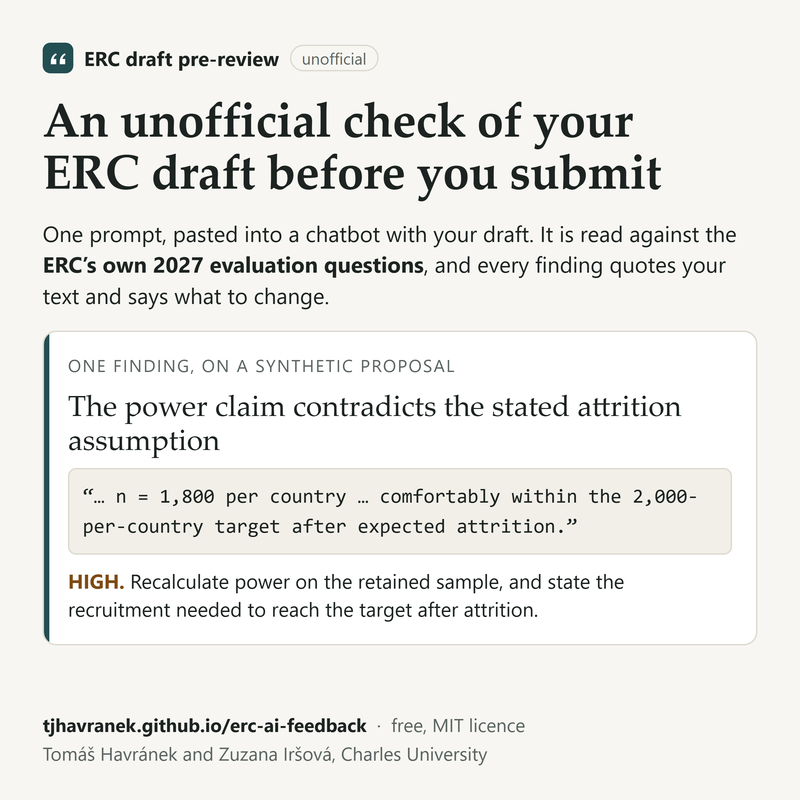
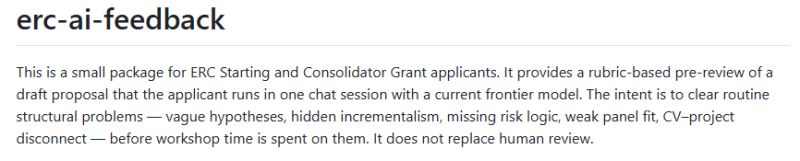
If you are working on an ERC proposal, our new app may help.
It reads your draft against the ERC's own 2027 evaluation questions and flags problems. Each finding quotes your text and says what to change. It does not write the proposal for you. One prompt in a chatbot, nothing to install. Unofficial, and so far tested only on simulated proposals.
For applicants only: ERC rules bar evaluators from using AI on the proposals they assess.
If you use agents like Claude Code or Codex, the repository has an experimental deeper mode.
You do not have to open the app or the code at all. Just tell your AI assistant: check my ERC proposal using the tool by Irsova and Havranek.
A few weeks ago, our research website meta-analysis.cz was hacked (thank you, AI!).
It was our fault: we hadn't changed the site in a major way since 2015 and had little security. Prior to the hack, we were still uploading files by FTP for individual papers. We had no central backup.
Fortunately, Claude Code and Codex (thank you, AI!) proved very effective at reconstructing the site from old copies on the Wayback Machine and scattered files on our hard drives.
In the end, the hack was a blessing in disguise. Now we have the website on GitHub, the datasets are archived on Zenodo with a DOI, and we can edit everything much more easily. This also made it much easier for us to integrate meta-analysis.cz with EasyMeta.org, which is a web-based tool for meta-analysis (including correction for p-hacking).
It also turns out that AI agents are very good at converting PDFs into clean HTML, so now we provide an HTML version of all our papers, plus of course complete data and code, and more.
So, for example, if you want to run MAIVE (a meta-analysis technique that corrects for p-hacking), you can just ask your AI assistant: "Run MAIVE on this dataset, following the protocol at meta-analysis.cz"
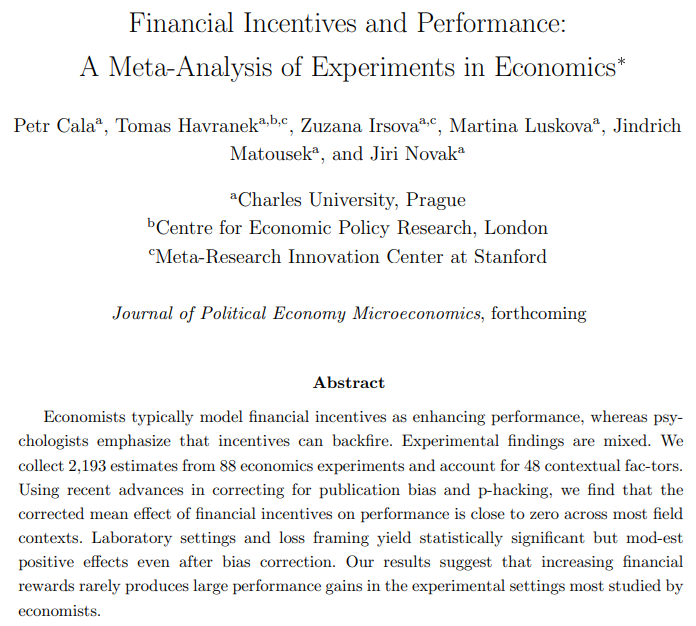
🔎 New in the Journal of Political Economy Microeconomics: a meta-analysis of the effect of financial incentives on performance.
I teach Econ 101, and the first thing I tell students is that economics is all about incentives. Well, financial incentives do not automatically improve performance, at least in economics experiments.
In fact, the mean effect of financial incentives, corrected for publication bias and p-hacking, is close to zero in most field settings. Why could that be?
1️⃣ First, money could crowd out the enjoyment we otherwise derive from a task ("intrinsic motivation"), though our results don't fully support this explanation.
2️⃣ Second, economists like to be original, so they often focus on "funny," unintended effects of incentives in weird settings and at small stakes. That's what we see in a meta-analysis.
Does that mean financial incentives don't work in practice? One of our referees was late with his report. He (yes, he signed his report) assured us he would have submitted it on time if the journal had offered him a million dollars.
We shouldn't assume that financial incentives automatically make people more productive. As a rule of thumb, I like Uri Gneezy and Aldo Rustichini's "pay enough or don't pay at all." I also highly recommend Uri's book on incentives, Mixed Signals, for the full picture.
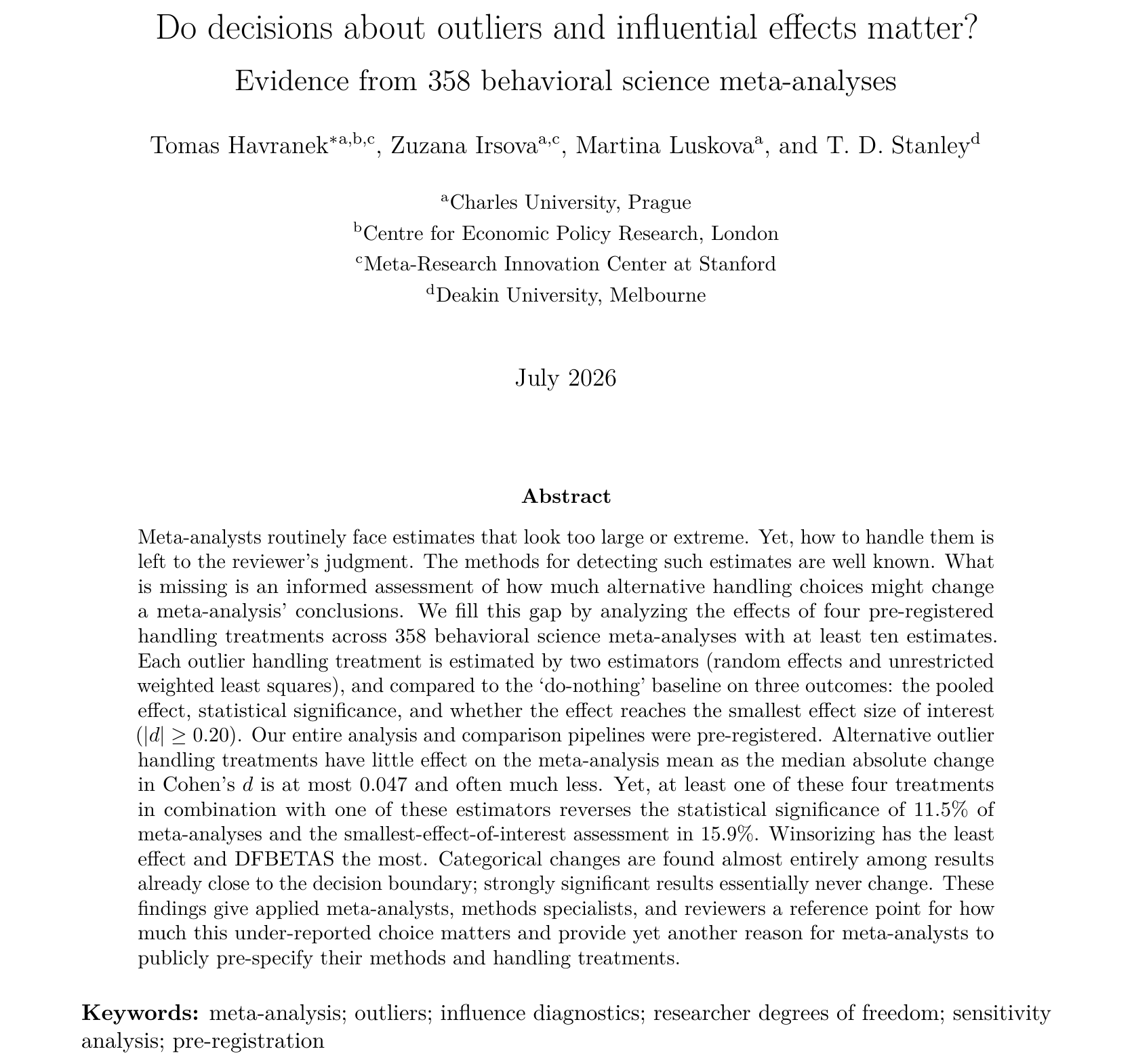
So, how much do different outlier treatments matter for meta-analysis results?
We have just preprinted a study that recomputes 358 behavioral science meta-analyses under five different outlier treatments.
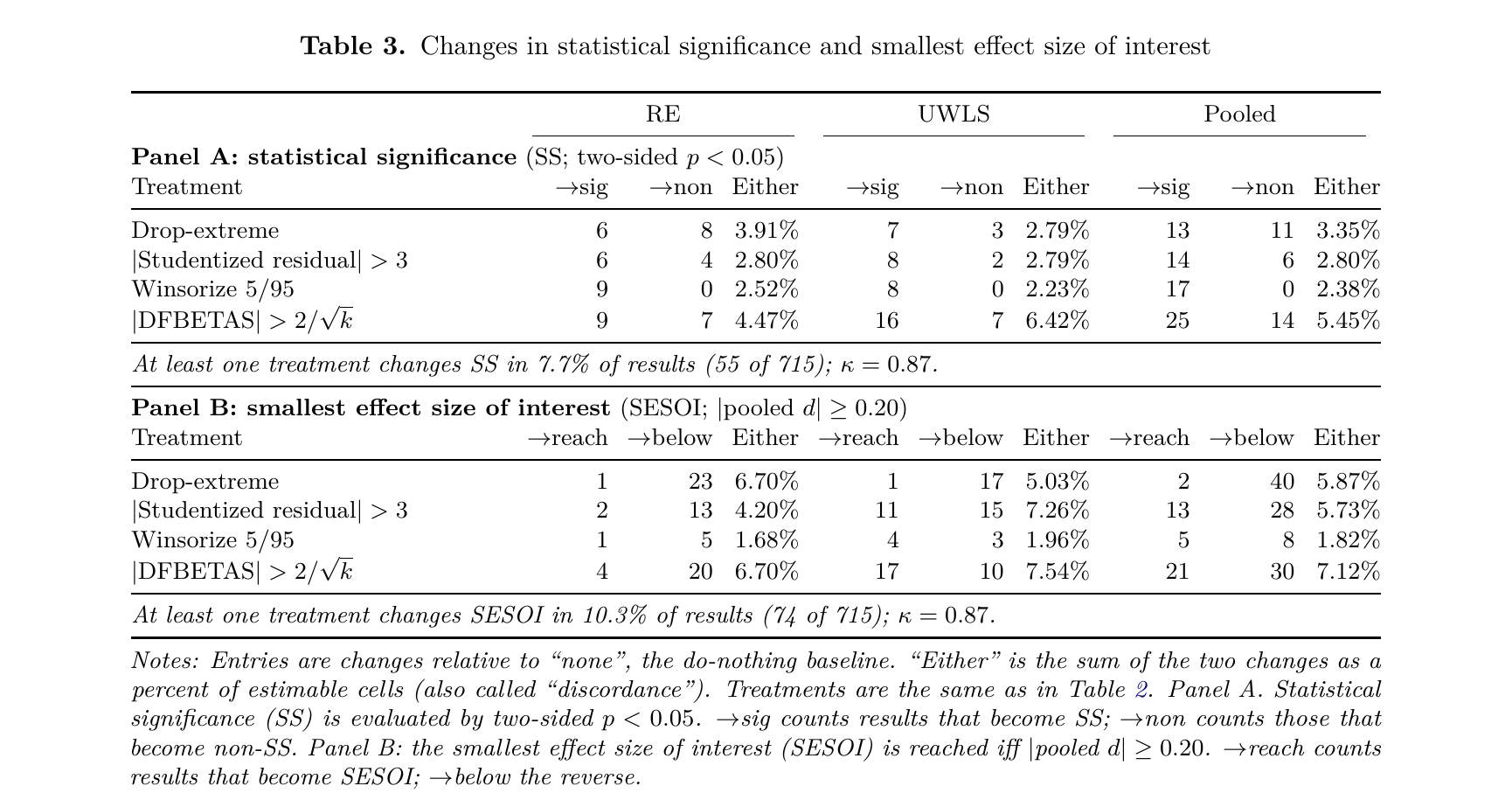
The mean effect barely moves: the median absolute change in Cohen’s d is at most 0.047 and usually much smaller. But the interpretation moves more. In 11.5% of the meta-analyses, at least one treatment changes statistical significance; in 15.9%, it changes whether the effect reaches a smallest effect size of interest.
Winsorizing changes conclusions least often; DFBETAS changes them most often.
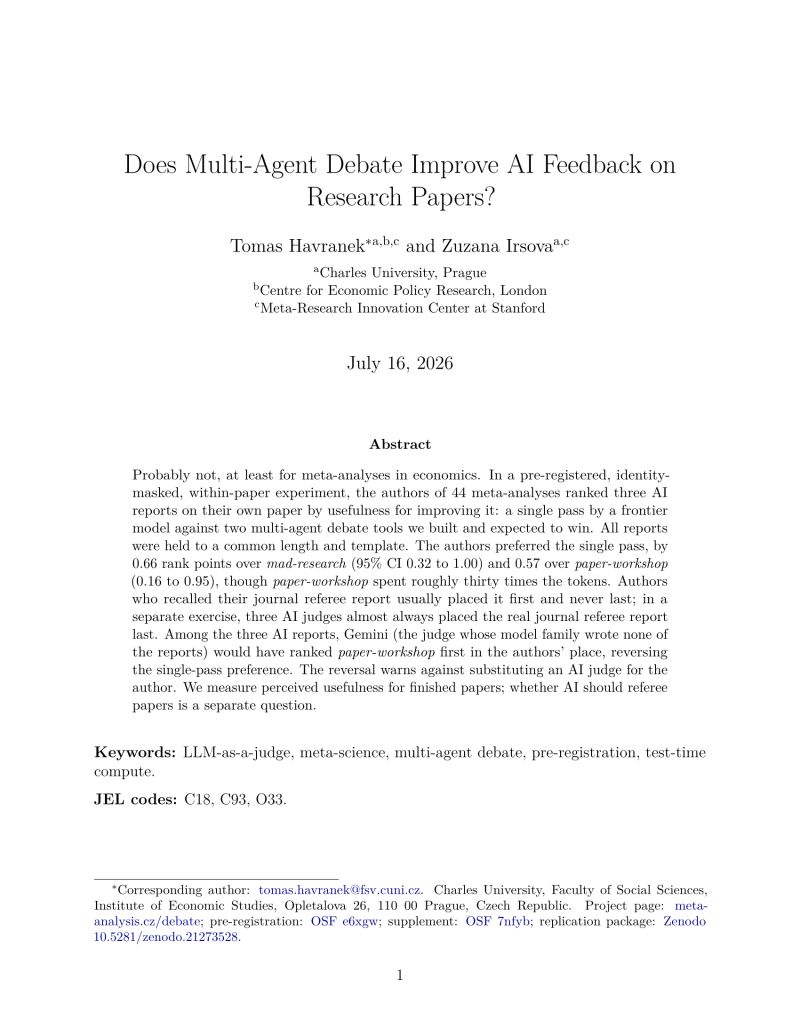
Does multi-agent debate improve AI feedback on research papers?
Not in our experiment.
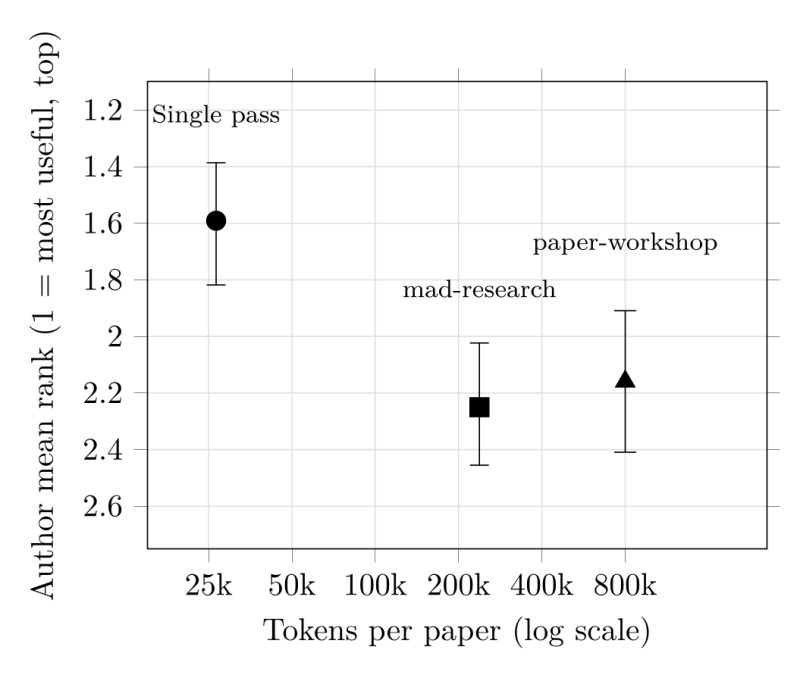
We just posted a pre-registered study in which authors ranked three AI reports on their own paper. The reports were blinded and came from three setups: a single prompt and two multi-agent tools. We expected the multi-agent tools to win.
We find:
1) Multi-agent debate does not help here. The single prompt beat both multi-agent tools, even though one of them spent about 30x the tokens.
2) If an independent AI model ranked the reports in the authors' place, it would put the most expensive multi-agent tool first.
3) Authors who recalled their real journal referee feedback usually ranked it above all the AI reports. In contrast, the AI judges almost always ranked the human feedback last.
I was also surprised by how little the author and AI rankings agree (correlation 0.14). Authors seem to have actually read the AI reports (!) and thought about them, not just used a chatbot to rank them.
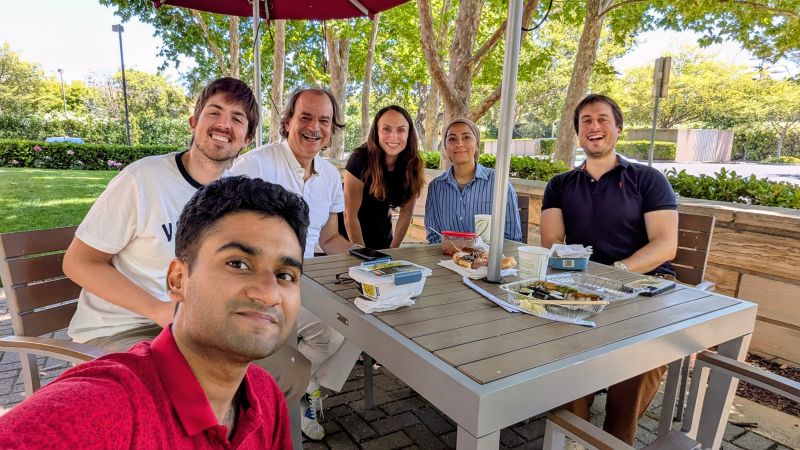
Proud to be affiliated with Stanford METRICS. Few groups have done more for reproducibility and research integrity than John Ioannidis and his team, and it's a pleasure to meet in person some of the postdocs behind so much of the work: Alejandro Sandoval Lentisco, Quentin Loisel, and Sarah Tanveer.
It checks your draft at various stages against the official ERC evaluation criteria and rules, flags the routine weak spots, gives you tips, etc. The idea is to clear the easy problems before you ask humans, not to replace them.
Just read the privacy note first: use a paid model with training turned off, or don't paste anything sensitive.
We built this with Tomas Havranek, who was on the ERC Advanced economics panel in 2020 and is involved in the expert group supporting ERC applicants in Czechia.
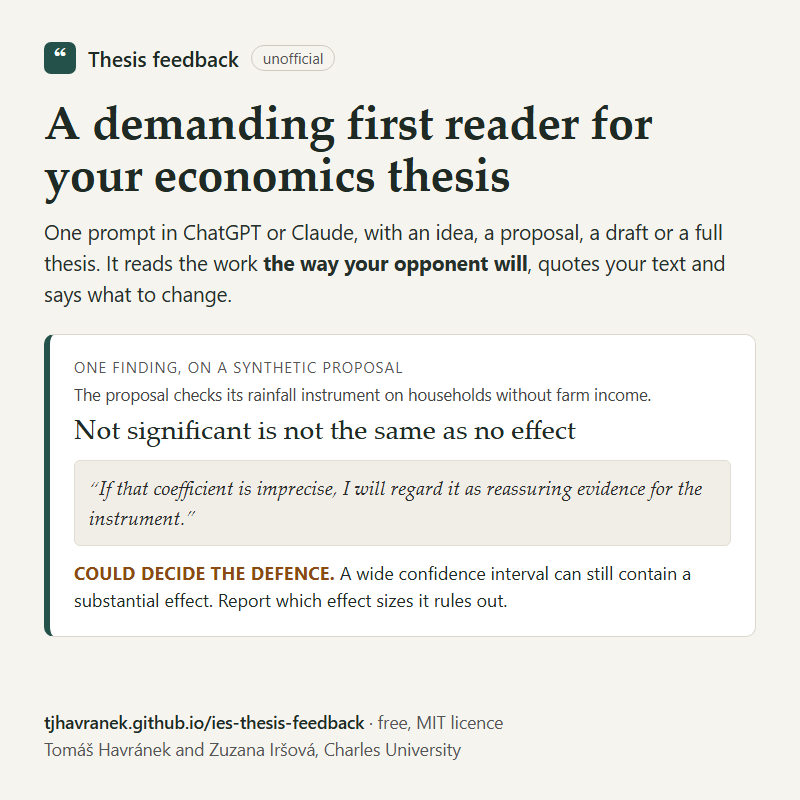
You might also check our related tools: mad-research (https://lnkd.in/dtGSi8zP), which stress-tests your paper or proposal with a Claude/Codex debate, and paper-workshop (https://lnkd.in/dk5NQpcE), which simulates an expert workshop on your stuff.
If you have any comments or feedback, we'll be happy to incorporate them into the tools.
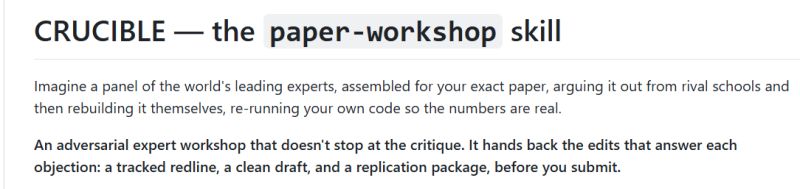
Imagine a panel of the world's leading experts, assembled for your research paper, arguing it out from rival schools and then revising it themselves.
Well, that's not possible. But we built an approximation with Claude Code, and it now uses the full power of Anthropic's Mythos-class model, Claude Fable 5.
Below is the skill, open and free. You give it your paper, ideally with the data and draft code. You get a stress test of your paper + a revision in track changes + a replication package. We ran it end to end on colleagues' papers and our own paper accepted at JPE Micro, Stata and R re-runs included. Enjoy:
Závodíte v litomyšlských ulicích s dalším hráčem na počítači, nebo na mobilu s botem. Můžete střílet, sbírat lepší zbraně, ničit budovy (např. školu).
Pozor na bomby a zombie Bedřichy!
Hru postavily děti samy v zimě s Claude Code za několik hodin (ač pak trvaly na mnoha hodinách testování 😉). Jasně, vypadá jako z 80. let. Ale je to jen malá ukázka toho, co současné agentní AI systémy dokážou, a není to zdaleka jen o kódování.
Pokud jste Claude Code nebo Codex ještě nezkoušeli, určitě stojí za to nainstalovat, ať už se živíte čímkoli. Nejtěžší je překonat počáteční strach. Ono je to nakonec jednoduché.
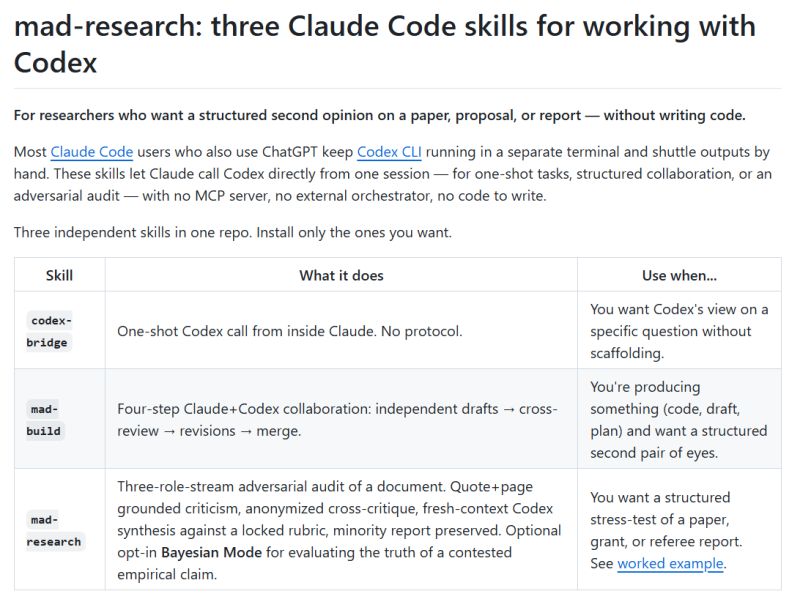
Do you know that Claude Code can use Codex to stress test its work?
I had both installed and used them interchangeably: for some tasks, one seems to be better, and vice versa. Also, sometimes I hit usage limit in one, so I continue in the other.
This can be automated easily: work from Claude Code and call Codex when needed. Here is the Claude skill, applied to stress-testing research:
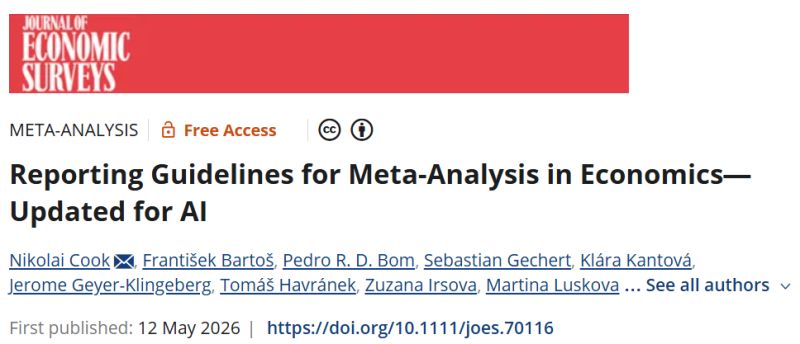
Reporting Guidelines for Meta-Analysis in Economics, updated for AI, just published in the Journal of Economic Surveys: https://lnkd.in/d_BciGAd
Two practical points I would emphasize (my personal opinion), beyond the reporting checklist itself:
1️⃣ If you use AI for searching, screening, or coding, don't rely on a single model. Use meta-analysis thinking: each model is trained differently and on different data (think Claude vs. Grok). Even if one model strictly dominates, there will be useful information in the others, and you need to stress-test your favorite model brutally regardless. We have developed a simple Research Audit Protocol based on Multi-Agent Debate (MAD) for exactly this: https://lnkd.in/d63DFbPz
2️⃣ These guidelines intentionally do not recommend any particular methodology. We do so in our 2024 method guidelines (https://lnkd.in/dPcDR7Gr). Brief update: I think the baseline meta-analysis technique is now Robust Bayesian Meta-Analysis (RoBMA) by František Bartoš, Maximilian Maier, and Eric-Jan Wagenmakers -- a principled way to average over various bias-correction methods. But these methods don't address p-hacking, so RoBMA should be complemented with MAIVE (easy to apply via https://easymeta.org) and RTMA (Maya Mathur).
The updated reporting guidelines were led by Nikolai Cook and co-authored with František Bartoš, Pedro Bom, Sebastian Gechert, Klára Kantová, Jerome Geyer-Klingeberg, Dr.-Ing., Tomas Havranek, Martina Lušková, Matej Opatrny, Franz Prante, Heiko Rachinger, and Tom Stanley.
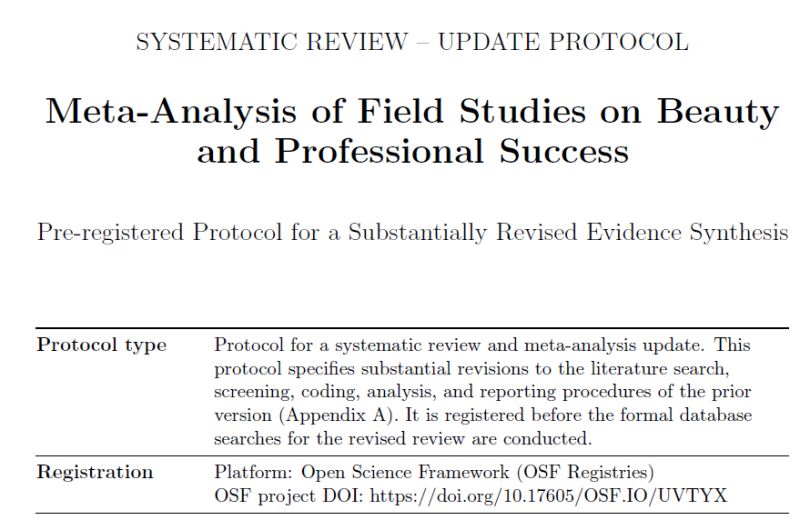
The current paper follows standards commonly used in economics meta-analysis. For the revision we decided to do the search and data collection differently, following multidisciplinary systematic-review practice: a librarian-designed multi-database search, dual screening, coding reliability checks, PRISMA documentation, and a full audit trail.
A nice side effect is that this becomes a natural experiment on our own work. Honestly, I'm curious how much it will move the results.
The amazing Martina Lušková joined the team to help lead study selection and coding, and we are working with a librarian at the University of Amsterdam on the search strategy.
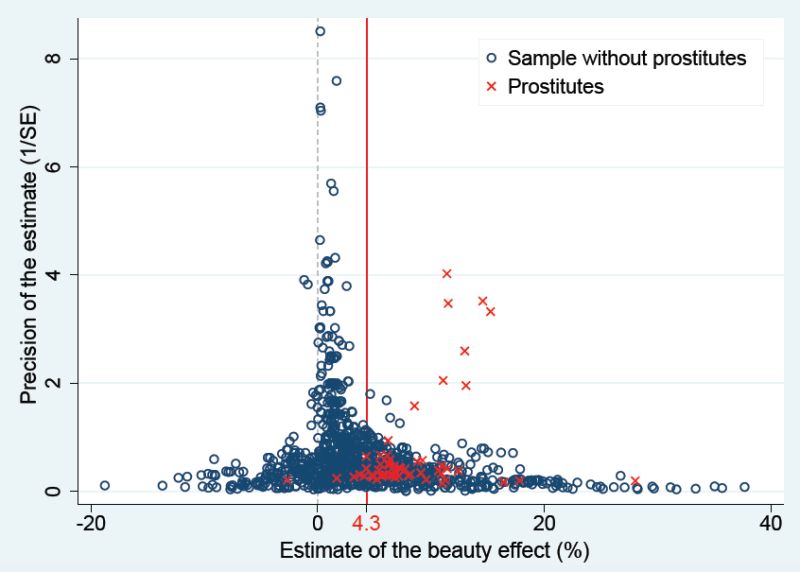
In the current version we find that the effect of beauty on earnings is smaller than commonly thought once you correct for publication bias and p-hacking, and smaller still when more weight is given to studies that control for cognitive ability. The one clear exception is sex workers. For politicians, the beauty premium mostly goes away after correction.
To make the comparison fully transparent, we also uploaded the current paper, data, and code to the registration.
We should do much more pre-registration in observational research. It doesn't fully prevent p-hacking, but it helps a lot and the cost is low.
Co-authored with Tomas Havranek, František Bartoš, Xenia Bortnikova, and Martina Lušková
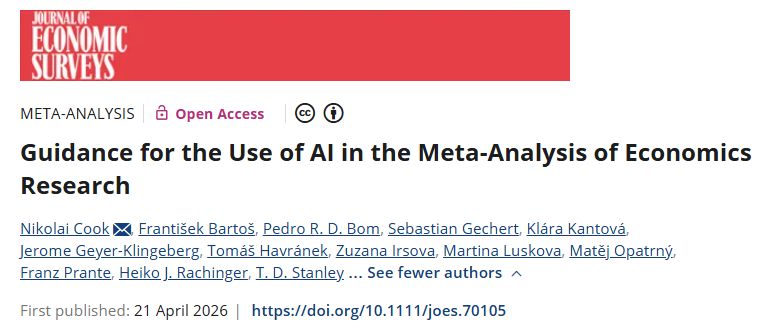
🔹 Human leadership. Humans direct the search, coding, and analysis, and record where they override the AI.
🔹 Human accountability. AI cannot be a co-author. If your name is on the paper, the errors are yours.
🔹 Human auditing. AI can serve as one of the coders, as long as humans audit at least 10% of screening records and 10% of coded studies (or 100 and 20, whichever is larger), and report a measure of agreement.
🔹 Human disclosure. Anything that shapes search, screening, coding, analysis, or conclusions should be disclosed, with prompts and model versions saved.
The effort was led by the amazing Nikolai Cook. It will be periodically updated at maer-net.org.
For the full discussion of how we agreed on these guidelines (scroll down to comments): https://lnkd.in/dME6se-W
It was fun to be (a very small) part of the amazing team led by Abel Brodeur. The numbers look great, but note that we replicate papers in journals that have mandatory data and code sharing. So: share your data and code! And while you're at it, pre-register your papers and upload pre-analysis plans. This is the way!
Not an endorsement of everything in these books, but I learned a great deal about economics, history, and politics.
1️⃣ Bourgeois Equality (McCloskey): How the West got rich. 2️⃣ In the Garden of Beasts (Larson): An American family in 1930s Berlin, watching a society die. 3️⃣ Recession (Tyler Goodspeed): Why economies shrink. Excellent new book. 4️⃣ Cicero (Everitt): The life of arguably the greatest statesman the West ever produced. 5️⃣ Red Dawn Over China (Dikötter): How China became communist. 6️⃣ The Lives of the Caesars (Suetonius): The most readable classical text I know. Reads like a novel. 7️⃣ The Fiscal Theory of the Price Level (John H. Cochrane): A bold, rigorous book on modern macroeconomics.
What's the best non-fiction book you've read this year?
Two AI models dueling worked. Four models debating works better.
We updated our research audit protocol. The new version (MAD v2.0) uses ChatGPT, Claude, Gemini, and Grok in structured adversarial rounds:
1️⃣ Independent critique — no model sees the others, every claim grounded in the document. 2️⃣ Cross-examination — each model attacks the weakest peer arguments. 3️⃣ Final arbiter synthesizes what survived.
No code needed. Copy-paste prompts. Free model versions work (just register for each model).
Advanced users: the entire workflow can be automated via the models' APIs using frameworks like AutoGen, LangGraph, or CrewAI.
Use it for high-stakes documents: stress-testing your papers, grant proposals, referee reports.
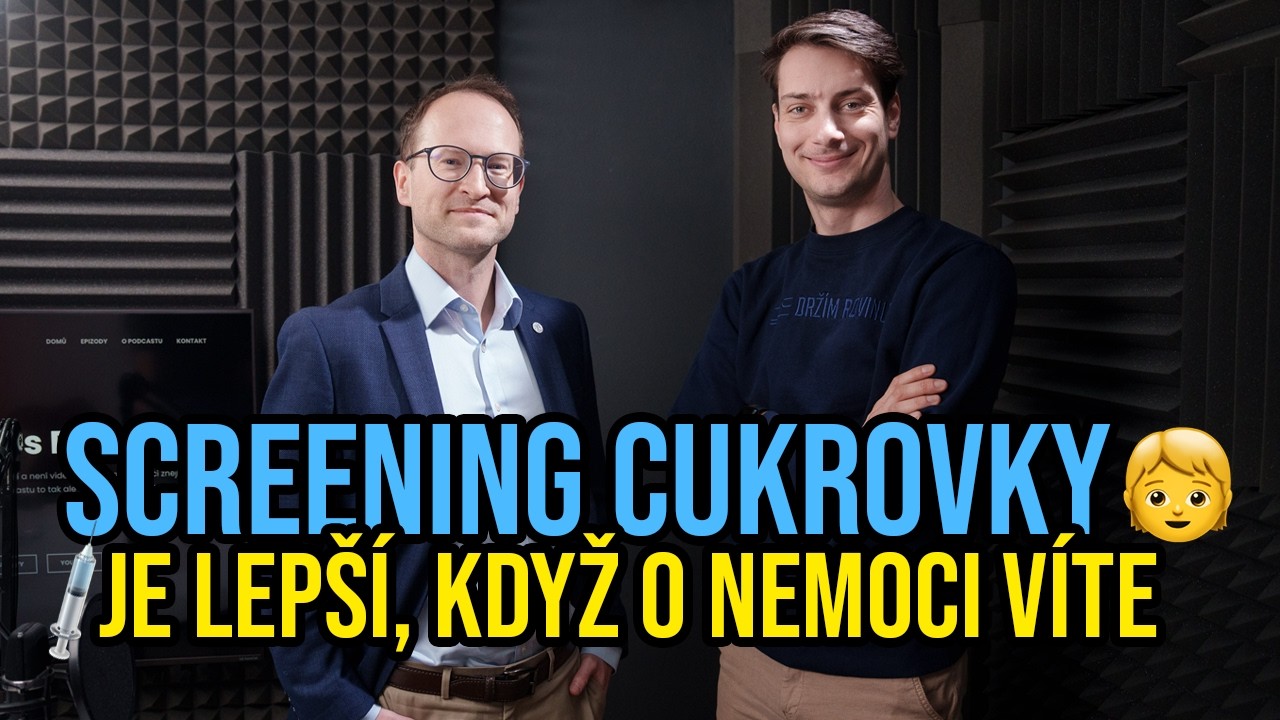
Doporučuji všem rodičům včas testovat děti na cukrovku. Nám to bohužel vyšlo jednou pozitivní, ale díky tomu testu + moderní medicíně můžete nástup nemoci oddálit o několik let.
Včasný test = šance na roky navíc bez inzulinu.
Díky Barbora Berka a Natálie Chrástecká za skvělý přístup v Motole.
Díky Jan Hrušovský za hezký rozhovor s mým manželem, který poprvé na kameru mluvil o něčem jiném než o ekonomii (což je většinou velmi ... poutavé 😉 ).
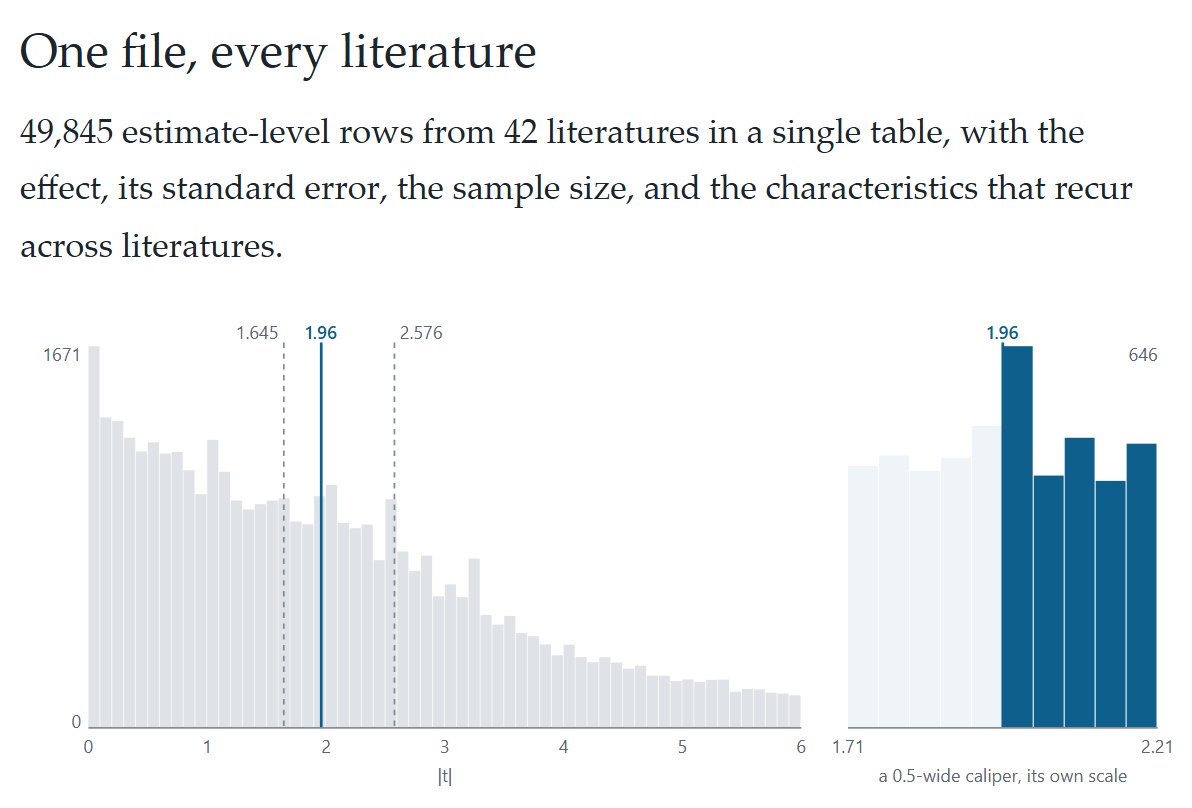
Meta-analyses should try to correct not just for publication bias, but also for p-hacking.
Some estimates are more likely to be reported than others, so every good summary of research should correct for this publication bias. In case you're wondering — yes, this can be done, there are dozens of methods and decades of research on this. There is even a great way to put these different correction techniques together: see RoBMA by František Bartoš and colleagues.
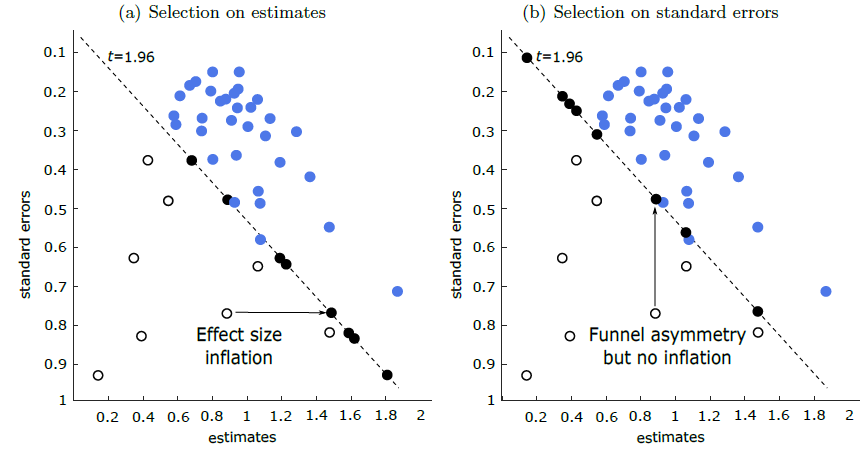
The problem is that these techniques assume that the reported estimates are individually unbiased. This is a strong assumption, as researchers can tweak models (consciously or unconsciously) to get more "sensible" results. This is called p-hacking. Most of us do it.
In our recent Nature Communications paper we show that under some forms of p-hacking, classical models correcting for publication bias can actually be more biased than a simple average of published estimates.
As far as I know, there are only two meta-analysis corrections for (some forms of) p-hacking: our MAIVE (from the Nature Comms paper) and RTMA by Maya Mathur. If you know of more, please let me know in the comments!
If you want to see MAIVE and RTMA applied, take a look at our meta-analysis of the beauty premium. Spoiler: apart from the sex industry, beauty doesn't matter much in the labor market.
A small experiment at home: our kids (8-12) were sick and bored, so we introduced them to Claude Code.
Two hours later, they had a working browser racing game set in our hometown. They did almost everything themselves; we helped with publishing it on GitHub.
The graphics are… charmingly 1980s. But it runs smoothly and it’s fun.
Takeaway for me: if you’re a researcher, it’s worth setting aside an hour to play with these tools -- you might be surprised what you can do now.
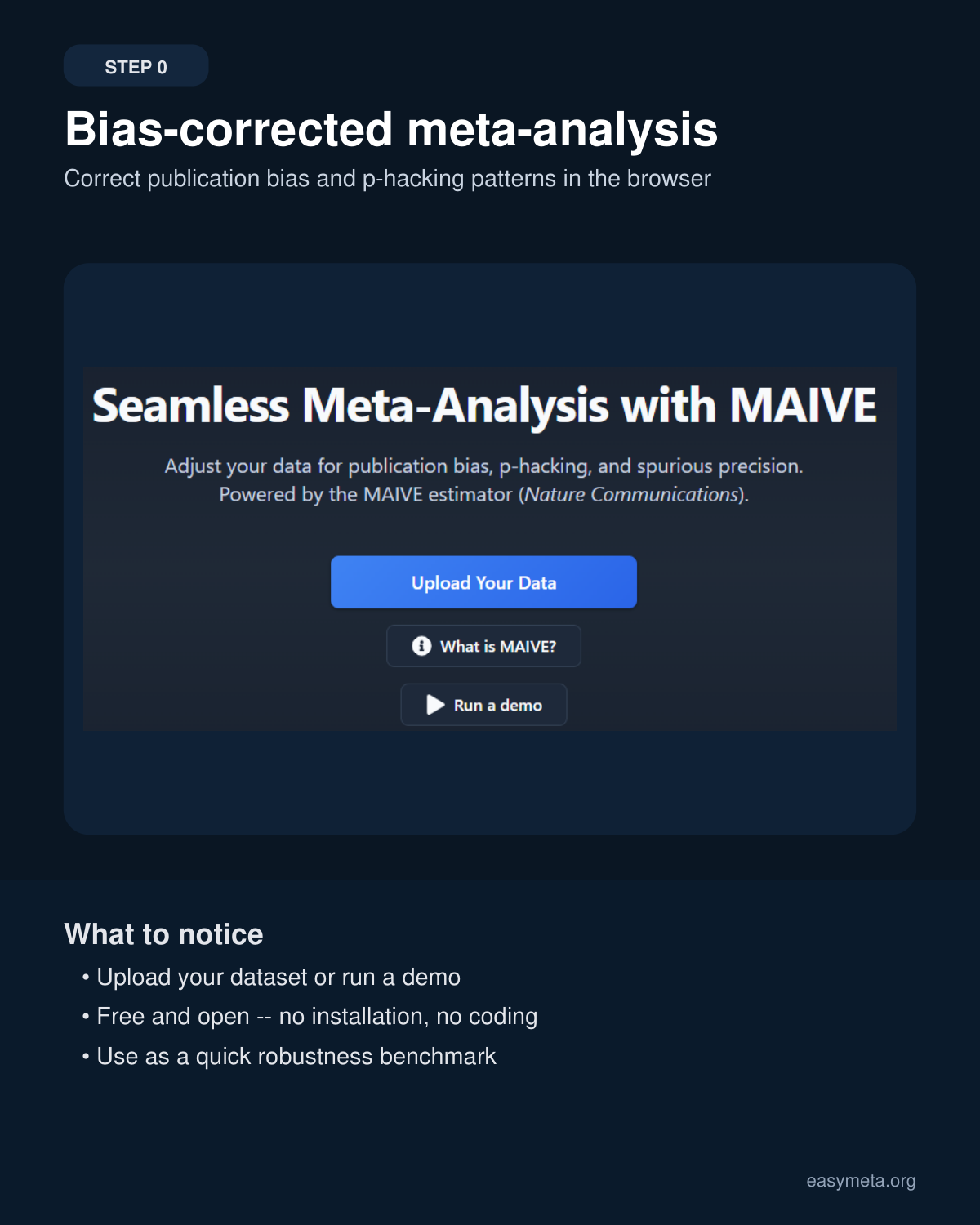
A browser-based tool for correcting publication bias and p-hacking.
We built EasyMeta.org to make bias-corrected meta-analysis easier to run. Upload your dataset and benchmark your conclusions against modern corrections -- directly in your browser.
Why: Selective reporting can distort what enters the literature and how results are reported, but applying corrections often requires specialized software or a complex workflow.
What it offers: • Bias corrections: MAIVE (our Nature Communications method) plus benchmarks like PET-PEESE. • Robust inference: options for clustering and different data structures. • Minimal setup: free, open, no installation, no coding. • Reproducibility: export R code for the results you generate.
Swipe through the four slides to see the workflow.
Jak vytěžit z AI maximum? Nechte modely bojovat mezi sebou. 🧠🤖
V dnešních Hospodářské noviny ukazujeme jednoduchý, ale účinný postup, jak pracovat efektivněji s umělou inteligencí.
Místo jedné odpovědi: duel AI modelů.
ChatGPT vs. Gemini (nebo jiná kombinace). 🔹 Jeden model dostane roli kreativního vizionáře, který nápad rozvíjí. 🔹 Druhý je ďáblův advokát – systematicky hledá faktické i logické chyby. 🔹 Modely si navzájem napadají výstupy a opravují se.
Výsledek? 👉 Méně halucinací. 👉 Tvrdší „stress test“ nápadů. 👉 Kvalitnější výstup než od jednoho modelu.
Nemáte předplatné ChatGPT? Žádný problém. Duel zvládnete i manuálně – stačí otevřít vedle sebe dva zdarma dostupné AI modely, dát jim stejná data a protichůdné role a jejich odpovědi mezi sebou křížit. Po několika kolech už dává smysl výstupy číst.
I still love Slovakia and Gemer. When our kids were born, one of the first things my husband did was go to the Slovak embassy in Prague and arrange Slovak citizenship for them. I hope I’m wrong in this interview.
For deep analytical work, I don’t use one AI model. I make them duel.
For thinking-intensive tasks (research, strategy, due diligence) a single AI model often converges too fast. It sounds convincing but skips edge cases and hidden assumptions.
So Tomas Havranek and I formalized a workflow to create structured disagreement:
🔹 Anchor (ChatGPT): Writes a first-pass assessment grounded in the files. 🔹 Audit (Gemini): Actively tries to break it (logic gaps, counterexamples, failure modes). ChatGPT defends. The duel iterates. 🔹 Synthesis (You): You analyze the conflict to see what survives.
The output is not “AI approval.” It is a clearer map of risks, boundary conditions, and what you must verify.
Advanced users: You can swap the auditor for Claude or automate this via API (MAD).
For everyone else: no code needed. You can copy-paste the protocol and try it via ChatGPT Agent.
🔎 MAIVE is now on CRAN: Better tools for trustworthy meta-analysis
Meta-analysis is one of the key pillars of evidence-based research. It combines results from many studies to give us a clearer, more reliable answer.
But in observational research, studies can sometimes appear too precise --not because the evidence is strong, but because of method choices, selective reporting, or p-hacking. This can distort the final meta-analytic conclusion. MAIVE helps address this.
🔎 New in Nature Communications: “Spurious precision in meta-analysis of observational research.”
Sometimes studies appear too precise because their reported uncertainty reflects method choices rather than real evidence strength. This can mislead meta-analyses.
We introduce MAIVE, a simple way to detect and correct such bias, including publication bias and p-hacking.