Two new pre-registered papers: outlier decisions in meta-analysis and AI feedback on meta-analyses
Post to the MAER-Net members' forum announcing two pre-registered papers. The headline is reproduced as posted: the platform cuts it after „on meta“, and the post's own URL is truncated the same way. In the original the two paper links are printed as bare URLs; here they are the same text, made clickable. The post itself carries no figures — the table and the chart below are reproduced from the two papers it announces, one from each, and are not part of what was posted.
My colleagues and I have two new pre-registered papers that may interest MAER-Net members.
1. Do decisions about outliers and influential effects matter?
(https://meta-analysis.cz/outliers, https://arxiv.org/abs/2607.23174)
With Zuzana Irsova, Martina Luskova, and Tom Stanley, we recompute 358 behavioral science meta-analyses under five outlier treatments: do nothing, drop the most extreme estimate, remove studentized residuals above 3, winsorize at 5/95, and remove estimates with |DFBETAS| above 2/sqrt(k). Each runs under random effects and UWLS. All data, thresholds, and rules were registered before we saw any results.
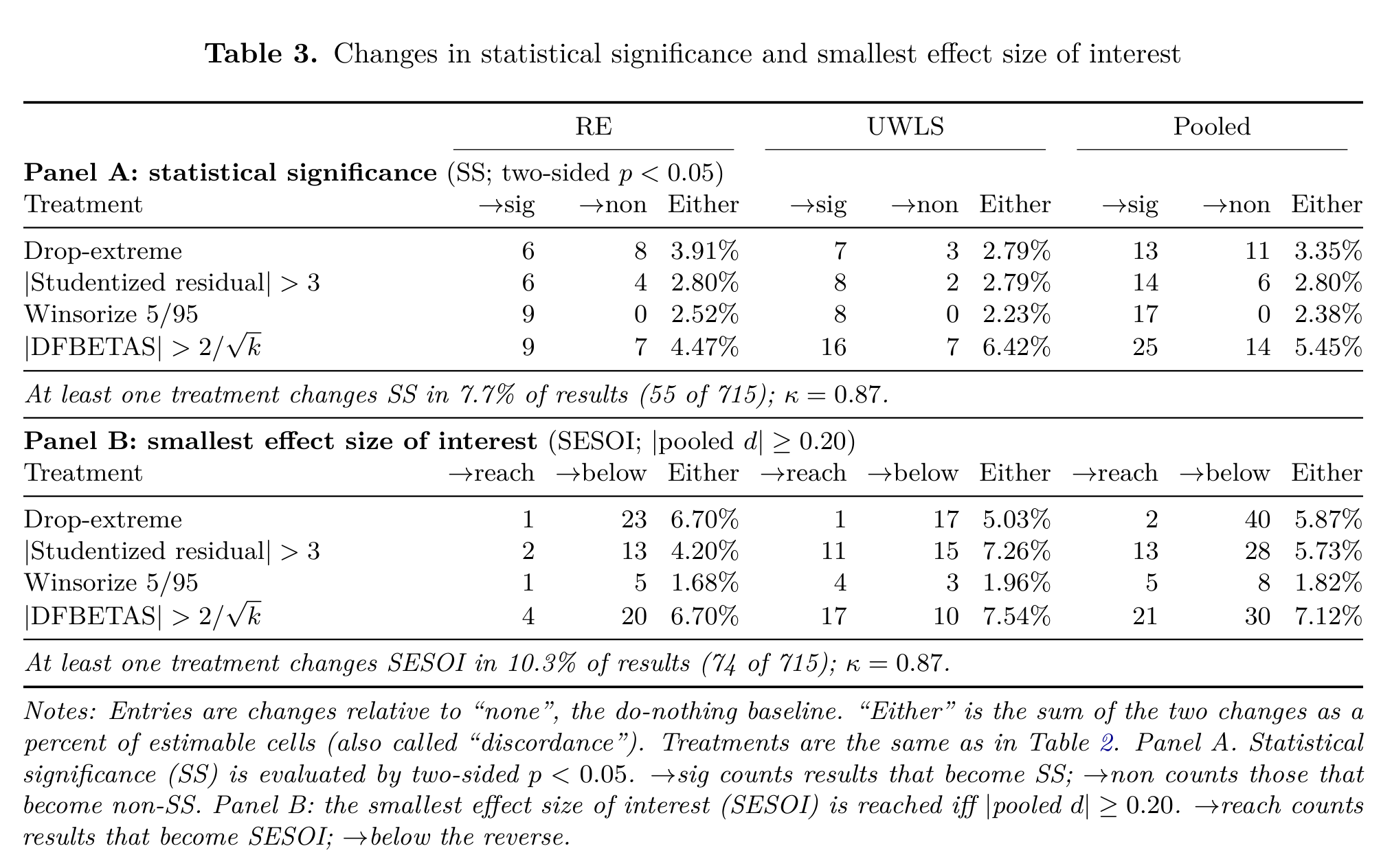
The mean effect barely moves: the median absolute change in Cohen's d is at most 0.047. Interpretation moves more. In 11.5% of the meta-analyses at least one treatment changes statistical significance, and in 15.9% whether the effect reaches a smallest effect size of interest (|d| >= 0.20). Nearly all flips are in results already close to the boundary; strongly significant results essentially never change. Winsorizing changes the fewest conclusions, DFBETAS the most, and DFBETAS computed with UWLS flags the most influential estimates. Takeaway: pre-register the outlier rule and report results with and without it.
2. Does multi-agent debate improve AI feedback on research papers?
(https://meta-analysis.cz/debate, https://arxiv.org/abs/2607.14713)
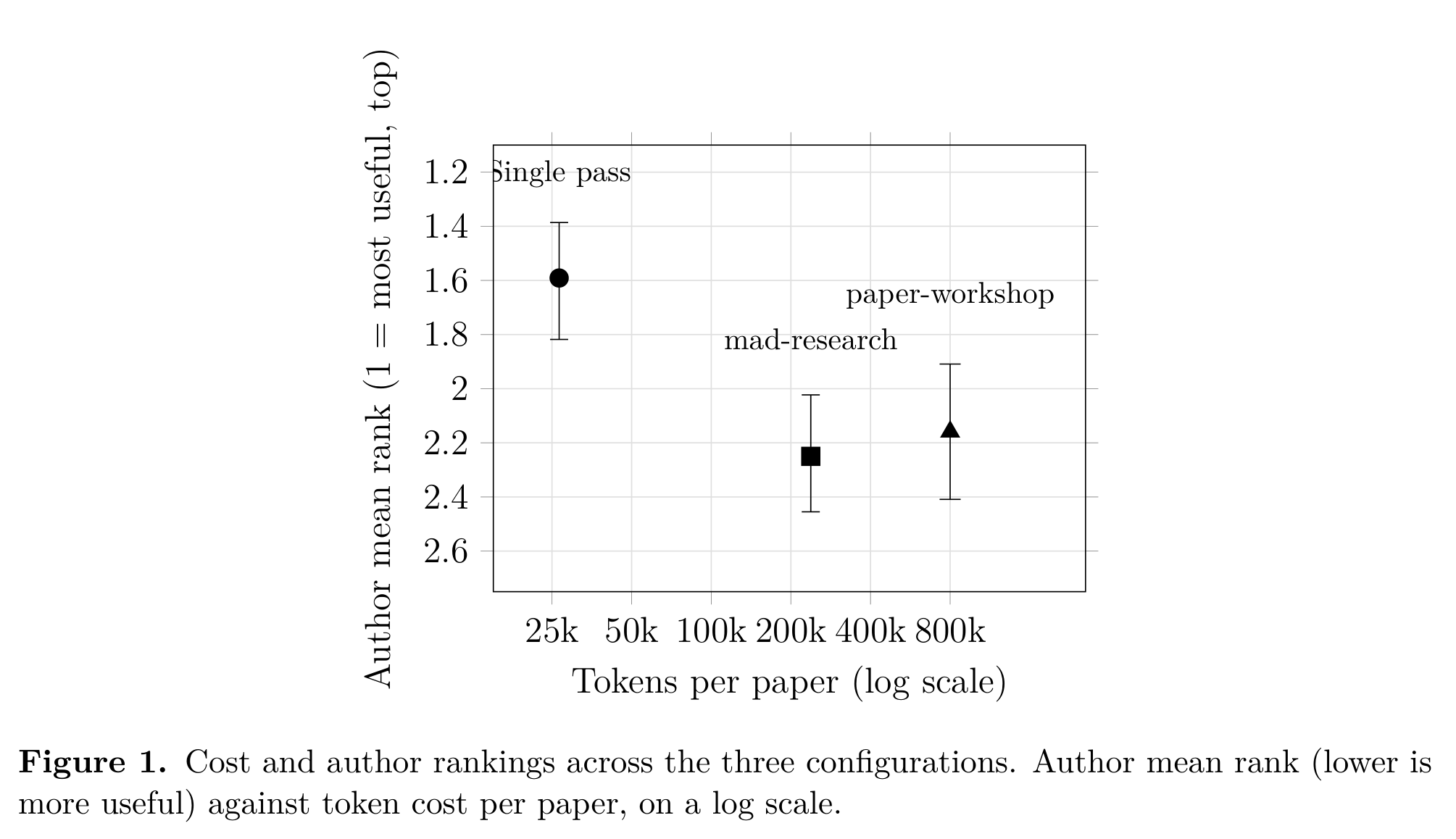
Many of you took part in this experiment with Zuzana and me -- thank you! Authors of 44 economics meta-analyses ranked three blinded AI reports on their own paper: a single pass by a frontier model against two multi-agent debate tools we built and expected to win. The single pass won, by 0.66 rank points over mad-research and 0.57 over paper-workshop, although paper-workshop spends about thirty times the tokens. Authors who recalled their journal referee report usually placed it first and never last; the AI judges almost always put the same human report last. And an independent AI judge (Gemini) would have reversed the authors' verdict and picked the most expensive tool. Takeaway: an AI judge is not a substitute for the author, so be careful with LLM-as-a-judge designs.
Both tools are open source: https://github.com/tjhavranek/mad-research and https://github.com/tjhavranek/paper-workshop
Comments are welcome!!
First published in MAER-Net, 27 July 2026. Original publication.