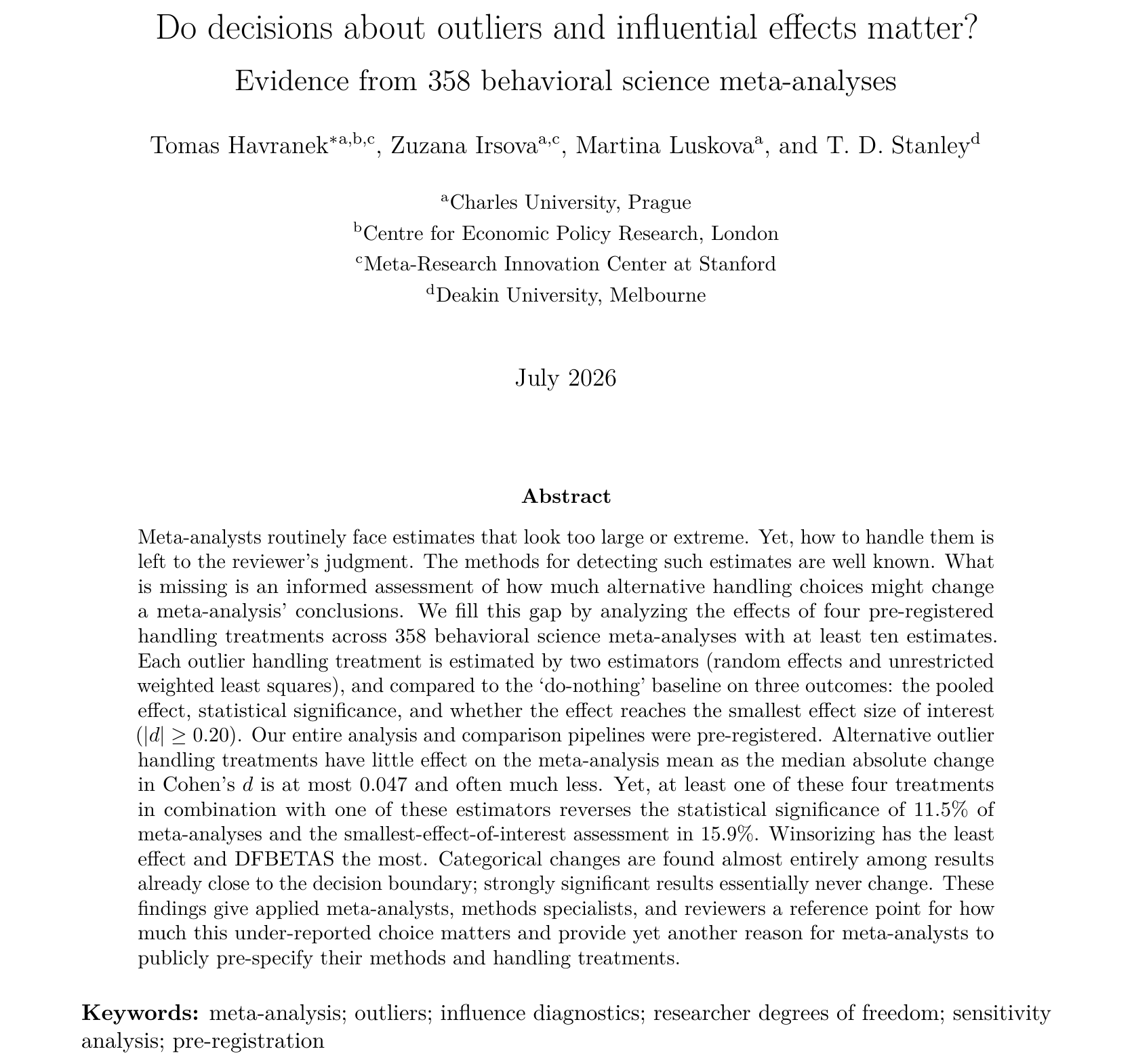
So, how much do different outlier treatments matter for meta-analysis results?
We have just preprinted a study that recomputes 358 behavioral science meta-analyses under five different outlier treatments.
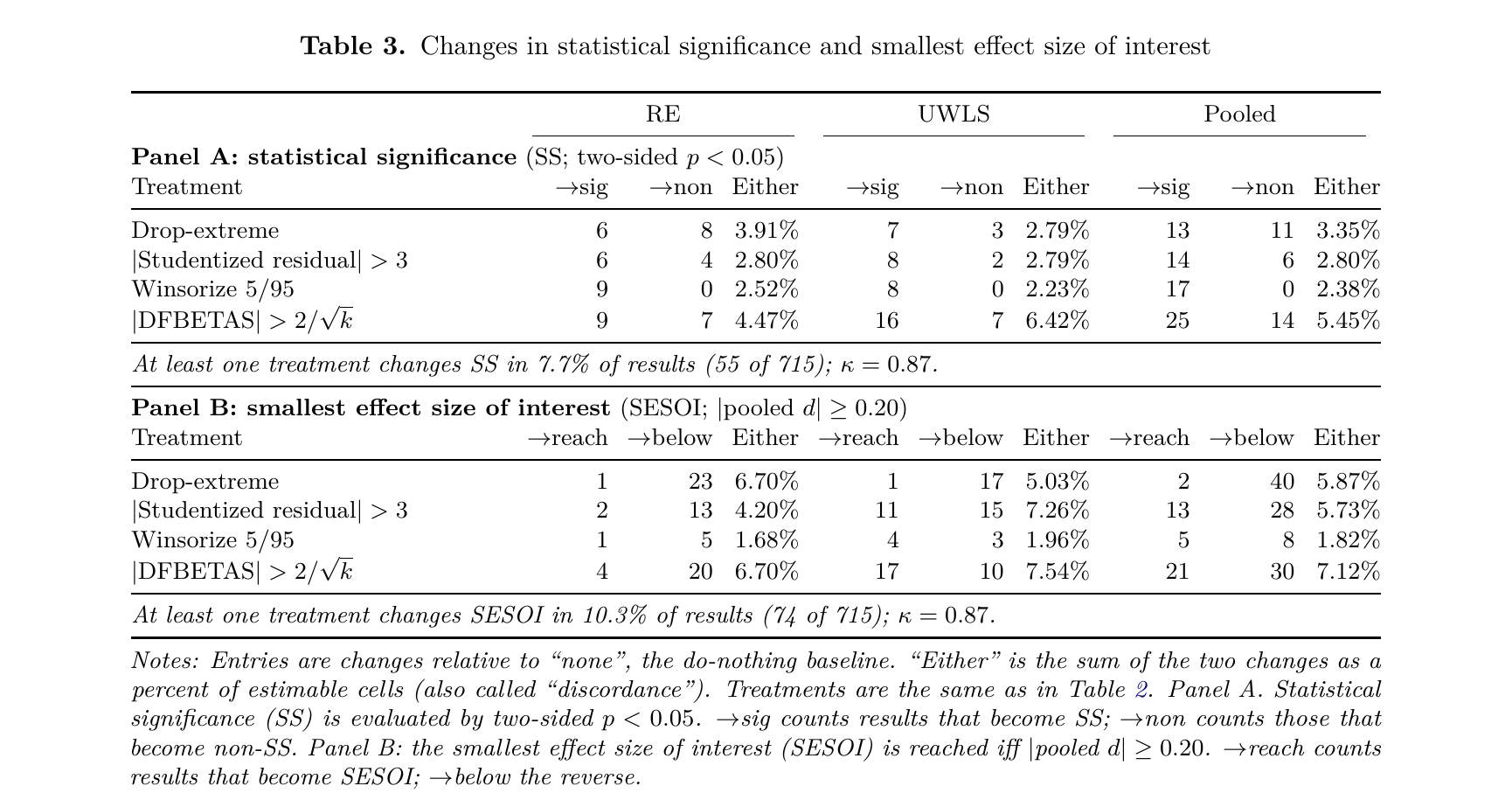
The mean effect barely moves: the median absolute change in Cohen’s d is at most 0.047 and usually much smaller. But the interpretation moves more. In 11.5% of the meta-analyses, at least one treatment changes statistical significance; in 15.9%, it changes whether the effect reaches a smallest effect size of interest.
Winsorizing changes conclusions least often; DFBETAS changes them most often.
Paper, online appendix, and data:
https://lnkd.in/dhtNgTMx
Pre-registration:
https://lnkd.in/du4_6YDT
Replication package:
https://lnkd.in/dQrKGiw2
Joint work with Tomas Havranek, Martina Lušková, and T. D. Stanley
Where the short links go:
lnkd.in/dhtNgTMx→ https://meta-analysis.cz/outlierslnkd.in/du4_6YDT→ https://doi.org/10.17605/OSF.IO/97CMVlnkd.in/dQrKGiw2→ https://doi.org/10.5281/zenodo.21216506