Abstract
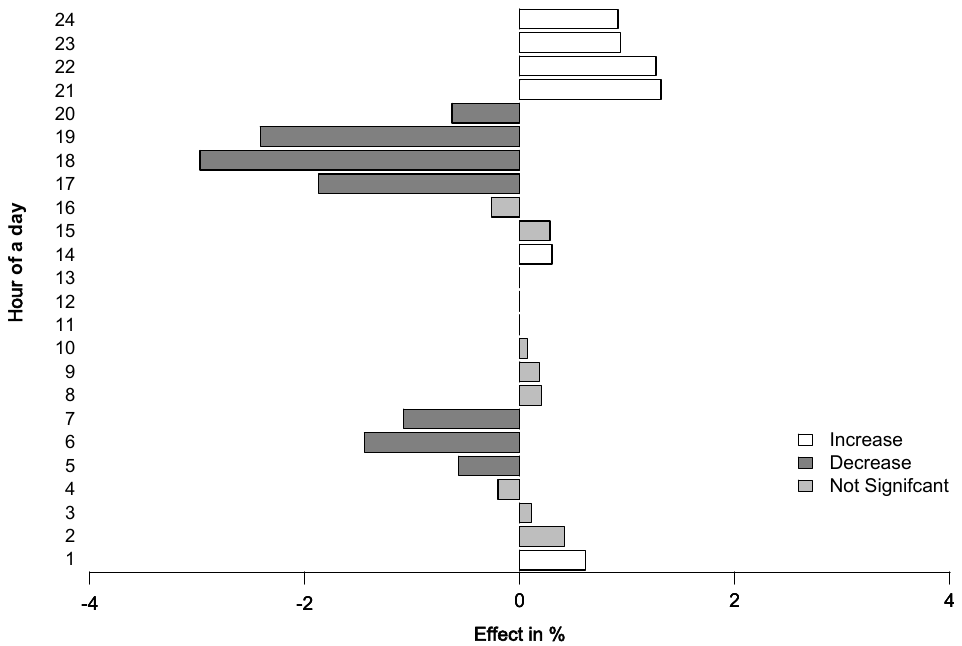
The European Union has recently decided to stop the policy of biannual clock changes in 2021. One reason is that the original rationale for the policy, energy savings, is not supported by a large portion of recent empirical studies. Whether the new permanent time will be standard time or the former daylight saving time has not been decided. Evidence on energy savings from daylight saving time is country-specific, and each country may choose its own time. We examine the effects of the policy in a country for which no studies on daylight saving exist, Slovakia. Using hourly data from the 2010–2017 period, we apply a difference-in-differences approach and estimate energy savings to equal 1% of annual electricity consumption. Alternatively, extrapolating the effect from the results of a previous meta-analysis on different countries, for Slovakia we obtain a smaller estimate, unlikely to exceed 0.5%. Moreover, our findings suggest that daylight saving time smooths the electricity demand curve.
Reference: Peter Kudela, Tomas Havranek, Dominik Herman, Zuzana Irsova (2020), "Does daylight saving time save electricity? Evidence from Slovakia." Energy Policy 137: 111146.
How to cite
Peter Kudela, Tomas Havranek, Dominik Herman, Zuzana Irsova (2020), "Does daylight saving time save electricity? Evidence from Slovakia." Energy Policy 137: 111146.
BibTeX
@article{kudela2020dst,
  author  = {Peter Kudela and Tomas Havranek and Dominik Herman and Zuzana Irsova},
  title   = {Does daylight saving time save electricity? Evidence from Slovakia},
  journal = {Energy Policy},
  year    = {2020},
  doi     = {10.1016/j.enpol.2019.111146},
}