Abstract
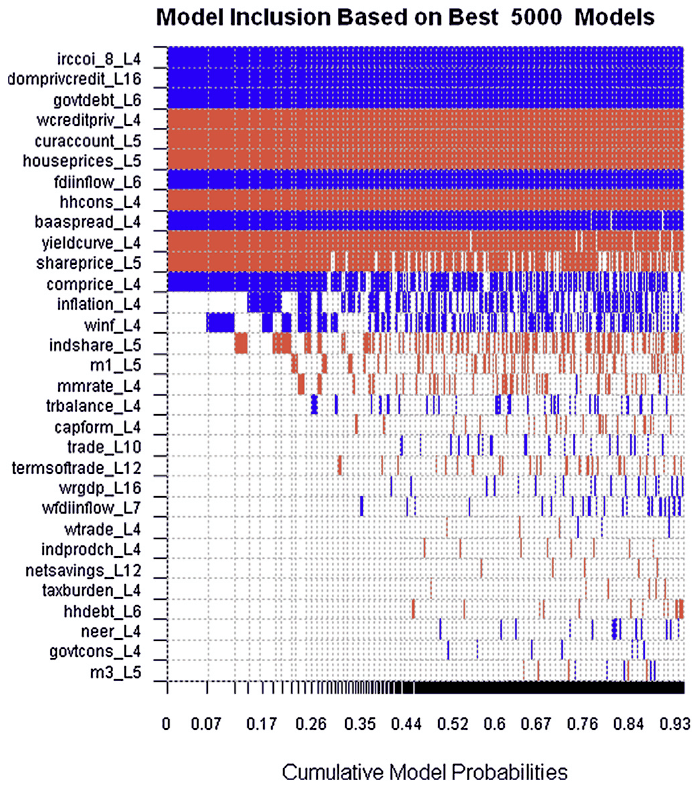
We examine which indicators are most useful in explaining the cost of economic crises in EU and OECD countries between 1970 and 2010. To define the dependent variable we combine a measure of costs to the economy, which consists of the output and employment loss and the fiscal deficit, with a database of crisis occurrence designed specifically for this task. We take into account model uncertainty in two steps. First, for each potential leading indicator we select the relevant prediction horizon by using panel vector autoregression. Second, we identify the most useful leading indicators with Bayesian model averaging. Our results suggest that domestic housing prices, share prices, and credit growth, and some global variables, such as private credit, constitute important sources of risk.
Reference: Jan Babecky, Tomas Havranek, Jakub Mateju, Marek Rusnak, Katerina Smidkova, Borek Vasicek (2013), "Leading indicators of crisis incidence: Evidence from developed countries." Journal of International Money and Finance 35: 1-19.
How to cite
Jan Babecky, Tomas Havranek, Jakub Mateju, Marek Rusnak, Katerina Smidkova, Borek Vasicek (2013), "Leading indicators of crisis incidence: Evidence from developed countries." Journal of International Money and Finance 35: 1-19.
BibTeX
@article{babecky2013leading,
  author  = {Jan Babecky and Tomas Havranek and Jakub Mateju and Marek Rusnak and Katerina Smidkova and Borek Vasicek},
  title   = {Leading indicators of crisis incidence: Evidence from developed countries},
  journal = {Journal of International Money and Finance},
  year    = {2013},
  doi     = {10.1016/j.jimonfin.2013.01.001},
}