Abstract

In this paper, we examine the usefulness of Google Trends data in predicting monthly tourist arrivals and overnight stays in Prague during the period between January 2010 and December 2016. We offer two contributions. First, we analyze whether Google Trends provides significant forecasting improvements over models without search data. Second, we assess whether a high-frequency variable (weekly Google Trends) is more useful for accurate forecasting than a low-frequency variable (monthly tourist arrivals) using Mixed-data sampling (MIDAS). Our results stress the potential of Google Trends to offer more accurate prediction in the context of tourism: we find that Google Trends information, both two months and one week ahead of arrivals, is useful for predicting the actual number of tourist arrivals. The MIDAS forecasting model that employs weekly Google Trends data outperforms models using monthly Google Trends data and models without Google Trends data.
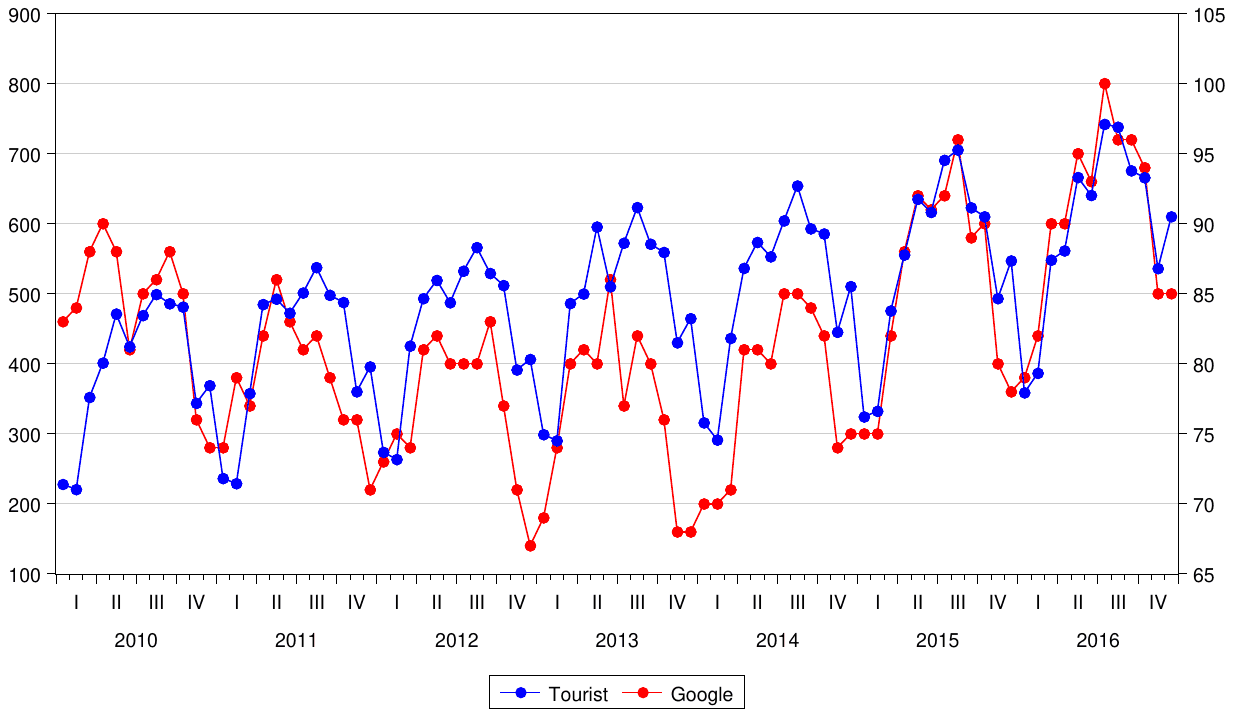
Monthly tourist arrivals to Prague and the monthly Google search index, 2010 to 2016, rising together and sharing the same seasonal swing
Fig: Monthly tourist arrivals to Prague against the monthly Google search index, 2010-2016.

The full text on this site is the working paper of November 2018, the fullest version of this article that is openly available. The article was published in Tourism Economics in 2021.

Reference: Tomas Havranek, Ayaz Zeynalov (2021), "Forecasting tourist arrivals: Google Trends meets mixed-frequency data." Tourism Economics 27(1): 129-148. doi.org/10.1177/1354816619879584

How to cite

Tomas Havranek, Ayaz Zeynalov (2021), "Forecasting tourist arrivals: Google Trends meets mixed-frequency data." Tourism Economics 27(1): 129-148. doi.org/10.1177/1354816619879584

BibTeX
@article{havranek2021tourist,
  author  = {Tomas Havranek and Ayaz Zeynalov},
  title   = {Forecasting tourist arrivals: Google Trends meets mixed-frequency data},
  journal = {Tourism Economics},
  year    = {2021},
  doi     = {10.1177/1354816619879584},
}