Abstract
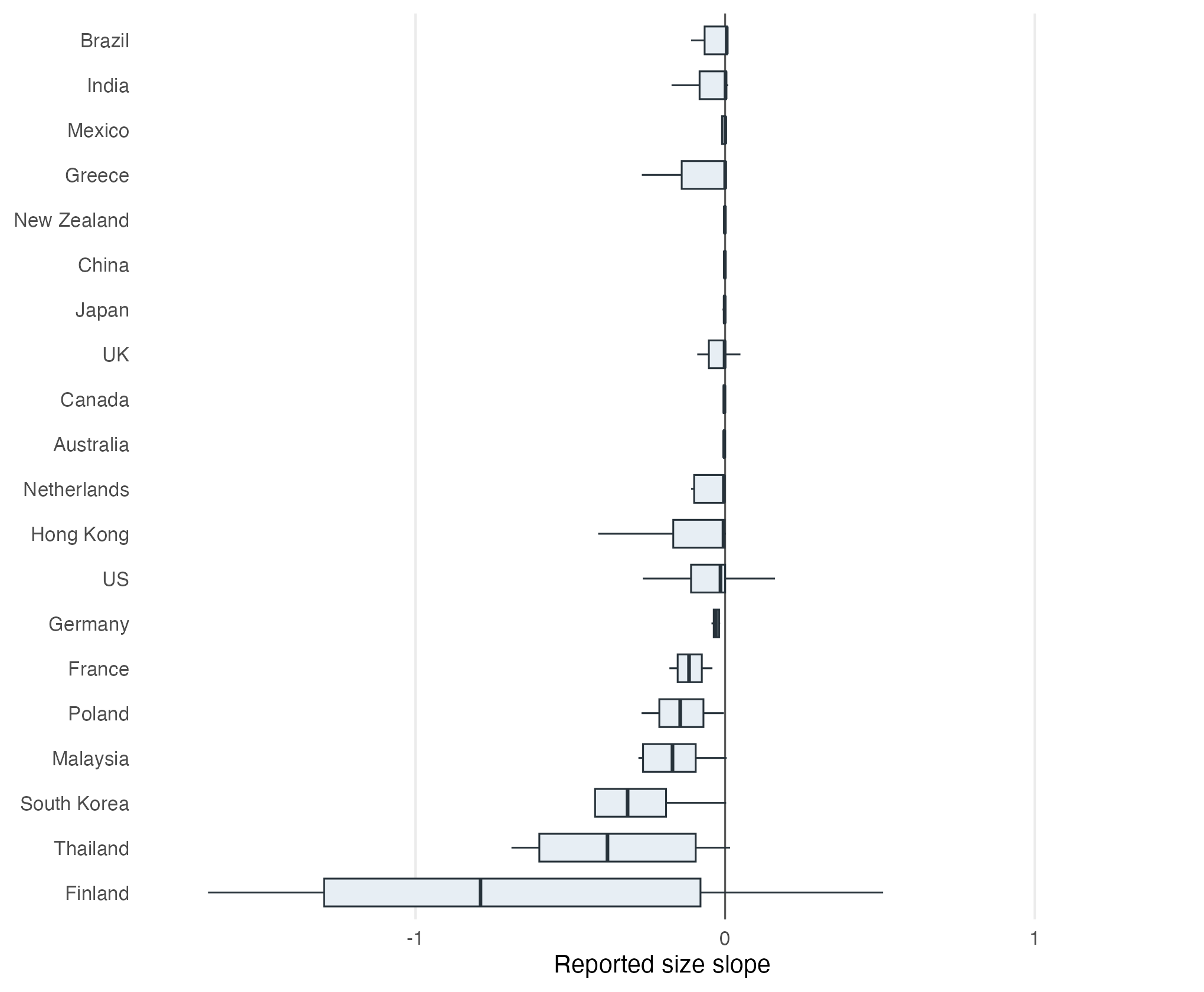
Reported estimates of the size premium, the tendency of smaller firms to earn higher average returns than larger firms, vary widely across studies, countries, periods, and designs. We examine whether generalized trust and rule of law help account for that heterogeneity. Small firms are more opaque and more dependent on outside finance, so the enforcement and information environment should matter more for them than for large firms. We study 1,613 reported size-slope estimates from 105 studies and 31 countries. The meta-regressions control for study design, specification, precision, publication context, and market and macro-financial conditions; Bayesian model averaging assesses uncertainty over the control set. The more stable association is with rule of law, and it runs against the intuitive expectation that better legal institutions shrink the premium: stronger rule of law is associated with more negative reported size slopes, hence larger conventional size premia. The trust association is conditional and less precisely estimated: where rule of law is weak, higher generalized trust is linked to less negative reported slopes (and thus a weaker premium), and this link fades as rule of law strengthens. Formal and informal institutions thus help organize part of the disagreement in this literature, although the analysis concerns variation in reported estimates and does not identify causal effects.
Reference: Jiri Schwarz, Tomas Havranek, Zuzana Irsova, Jiri Novak (2026), “Trust, Rule of Law, and the Size Premium: Evidence from a Meta-Analysis.” Anglo-American University and Charles University, Prague. Available at meta-analysis.cz/trust.
Headline result
Trust, rule of law, and the size premium in stock returns: the meta-analytic finding is stronger rule of law, larger size premium (association in reported estimates, not causal), based on 1,613 estimates from 105 studies and 31 countries (Schwarz et al. 2026).
How to cite
Jiri Schwarz, Tomas Havranek, Zuzana Irsova, Jiri Novak (2026), “Trust, Rule of Law, and the Size Premium: Evidence from a Meta-Analysis.” Anglo-American University and Charles University, Prague. Available at meta-analysis.cz/trust.
BibTeX
@misc{schwarz2026trust,
  author  = {Jiri Schwarz and Tomas Havranek and Zuzana Irsova and Jiri Novak},
  title   = {Trust, Rule of Law, and the Size Premium: Evidence from a Meta-Analysis},
  year    = {2026},
}