Should Inflation Measures Used by Central Banks Incorporate House Prices? The Czech National Bank's Approach
Mojmir Hampl, Tomas Havranek (2017), "Should Inflation Measures Used by Central Banks Incorporate House Prices? The Czech National Bank's Approach." Czech National Bank Research and Policy Notes 1/2017. https://www.cnb.cz/export/sites/cnb/en/economic-research/.galleries/research_publications/irpn/download/rpn_1_2017.pdf. The text here is the working paper. The note also circulated as IES Working Paper 2017/12 under the title “Should Inflation Measures Used by Central Banks Incorporate House Prices? The Czech Approach”, and a version titled “Should monetary policy pay attention to house prices? The Czech National Bank’s approach” appears in BIS Papers No 94 (2017), pages 129-140.
Mojmír Hampl and Tomáš Havránek*
* Mojmír Hampl, Vice-Governor, Czech National Bank, e-mail: mojmir.hampl@cnb.cz;
Tomáš Havránek, Advisor to the Board, Czech National Bank and Institute of Economic Studies, Charles University, Prague, e-mail: tomas.havranek@cnb.cz.
We thank the participants of the BIS Emerging Market Deputy Governors Meeting in Basel, February 20–21, 2017, Chris Jeffery (the Editor of Central Banking Journal), Vít Bárta, Oldřich Dědek, Jan Frait, Michal Hlaváček, Petr Král, Simona Malovaná, and Jiří Schwarz for useful comments on previous versions of this note. We are especially grateful to Jan Brůha and Jakub Seidler for detailed referee reports and to Branislav Saxa and Ivana Kubicová for initial work on the CPIH index that constitutes the main focus of this note.
The views expressed here are ours and not necessarily those of the Czech National Bank.
Reviewed by: Jakub Seidler (ING Bank), Jan Brůha (Czech National Bank)
Project Coordinator: Michal Hlaváček
© Czech National Bank, June 2017
Abstract
In this note we describe the Czech National Bank’s approach to incorporating macroprudential considerations into monetary policy decision making: the use of a broader inflation measure that gives substantial weight to house prices and is considered along with headline CPI inflation. We argue that, in terms of theory, the broader inflation gauge is at least as suitable for measuring the value of money as headline CPI inflation is, but we also acknowledge practical problems that arise from the use of the broader index.
Keywords: Consumer price index, financial stability, house prices, macroprudential policy, monetary policy, owner-occupied housing. JEL Codes: E31, E44, E50, R30.
Abstrakt
V tomto článku popisujeme jeden z možných přístupů České národní banky k částečnému integrování politiky v oblasti finanční stability do rozhodování o tradičních měnověpolitických otázkách. Tímto přístupem je použití širšího měřítka inflace, které dává významnou váhu cenám rezidenčních nemovitostí a je bráno do úvahy spolu s oficiální spotřebitelskou inflací. Argumentujeme, že z teoretického hlediska je širší měřítko inflace nejméně stejně vhodné pro měření změny kupní síly peněz, ale také přiznáváme praktické problémy, které jsou s jeho využitím spojeny.
Nontechnical Summary
We describe a new experimental measure of inflation that incorporates house prices and enters the monetary policy considerations of the Czech National Bank as a supplementary indicator. The purchase of dwellings intended for the satisfaction of the buyers’ own housing needs is close in its function to other durable goods and, in this logic, could be included in inflation with a corresponding weight. Moreover, when inflation measures include house prices, monetary policy is able to incorporate some of the financial stability considerations in a straightforward manner. Saying so does not diminish the importance of purely macroprudential tools, which have also been implemented by the Czech National Bank. But these rather new tools have their limits; for example, while they seem to work well in tightening the financial cycle, we have scarce evidence on the functioning of purely macroprudential tools when it comes to the need to ease conditions on the financial market. Paying more attention to house prices when conducting monetary policy allows us to utilize the main and well-tested tool of the central bank, the interest rate, which also has strong effects on house prices (Williams, 2015).
We do not argue, however, that the time has come to replace the current inflation measures with broader indices that fully incorporate house prices. Rather, we consider such broader measures of inflation to be useful supplementary indicators, similar in this function to core inflation, which, in contrast, constitutes a narrower gauge than headline CPI inflation. A major technical limitation of the broader index is that, at present, reliable data on house prices are available only at quarterly frequency and with a significant lag. Moreover, several alternative measures of house prices exist in the Czech Republic (see, for example, Hlaváček and Komárek, 2011); each has its pros and cons. The internationally comparable data that we use are subject to subsequent revisions, which imposes further practical problems and somewhat reduces the usability of the broader index.
1. Introduction
The Czech Republic is one of the few countries where headline CPI inflation directly includes house prices. Such inclusion, however, is mostly symbolic, because house prices account for just 16% of the owner-occupied-housing component of the CPI, which in turn represents only 9% of the CPI; this approach gives house prices a 1.4% weight in headline inflation (for comparison, tobacco has a 5% weight). Moreover, the data on house prices only cover purchases of dwellings that are new to the household sector, so all transactions between households are excluded from the CPI even though the vast majority of real estate deals occur on the secondary market. There are good practical reasons for such treatment, and the Czech Statistical Office, the agency responsible for computing the CPI, is at the frontier concerning the approach to measuring owner-occupied housing (its current approach is very close to the one Eurostat will probably incorporate into the HICP in 2018 or 2019). Nevertheless, house prices not only play a prominent role for macroprudential policy, but also reflect important expenditure that a typical household makes at least once and that influences its consumption behavior relevant to other segments of the CPI. Indeed, the purchase of dwellings intended for the satisfaction of the buyers’ own housing needs is close in its function to other durable goods and, in this logic, could be included in inflation measures with a corresponding weight.
When the CPI includes house prices, monetary policy is able to incorporate some of the financial stability considerations in a straightforward manner. Saying so does not diminish the importance of purely macroprudential tools, which have also been implemented by the Czech National Bank (such as a non-zero countercyclical capital buffer, a buffer rate for systemically important banks, and a limit on loan to value for mortgages; for an overview of macroprudential instruments in a small EU economy, see Frait and Komárková, 2012). But these rather new tools have their limits; for example, while they seem to work well in tightening the financial cycle, we have scarce evidence on the functioning of purely macroprudential tools when it comes to the need to ease conditions on the financial market. Paying more attention to house prices when conducting monetary policy allows us to utilize the main and well-tested tool of the central bank, the interest rate, which also has strong effects on house prices (Williams, 2015). Thus we call for a syncretic approach: leaning against the wind not using the interest rate solely, but in tandem with macroprudential measures and with the symmetry inherent to the inflation target in mind. We do not explore formally the interaction between monetary and macroprudential policy; readers interested in such a treatment can inspect, for example, Malovaná and Frait (2016). Similarly, for more in-depth studies on house prices in the Czech Republic we refer the readers to Brůha et al. (2013), Brůha and Polanský (2014), Hejlová et al. (2017), and Hlaváček and Komárek (2009).
The remainder of the note is structured as follows. In Section 2 we discuss why it makes sense from a macroprudential point of view to consider a broader measure of inflation that also includes house prices. In Section 3 we argue that there are strong reasons to pay attention to house prices purely from the monetary policy perspective, too. In Section 4 we outline how statistical bureaus measure inflation related to owner-occupied housing. In Section 5 we describe the experience of the Czech National Bank in this field. Section 6 concludes the note.
2. Macroprudential Reasons for Incorporating House Prices into the CPI
The Great Recession was famously preceded by a housing bubble in the US. In the aftermath of the crisis, many economists have constructed early warning systems, in which house prices are often found to play a prominent role (see, among others, Babecký et al., 2011; Reimers, 2012; Babecký et al., 2013; Antunes et al., 2014; Laina et al., 2015; and Tölö, 2015). The issue is also described in the classical book on financial crises by Kindleberger and Aliber (2015) and by Reinhart and Rogoff (2009). Especially in developed countries and during recent decades, house prices have tended to increase fast before a crisis, decrease markedly during the crisis, and rise only gradually when the first signs of recovery kick in. The prominence of house prices among the large number of potential early warning indicators has led many commentators to stress the interaction between this variable and the stance of monetary policy. As with many other issues in the recent discussion on macroprudential policy, however, it is perhaps not surprising that no clear consensus on the matter has yet been reached.
One stream of thought, represented, for example, by Assenmacher-Wesche and Gerlach (2010) and Svensson (2014), puts forward the notion that using monetary policy as a tool to stem an increase in house prices is too costly and detrimental to the welfare of the country. Williams (2015) conducts a meta-analysis of the empirical estimates reported in this literature and finds that a typical result implies a 1% loss in GDP associated with a 4% reduction in house prices delivered by monetary policy contraction. Often missing from the discussion, however, are the positive effects of such a policy on GDP and employment in times of downturn, when traditional CPI targeting implies less easing than what would be optimal if house prices were also taken into account. In other words, it is important to realize the symmetrical nature of inflation targeting even if the definition of the targeted statistical series changes.
Several studies have demonstrated the usefulness of incorporating financial stability considerations (including, most prominently, house prices) into monetary policy rules under inflation targeting. Because our focus is the Czech Republic, we are mostly interested in evidence for small open economies. Aydin and Volkan (2011) provide such evidence using a structural model calibrated for the case of South Korea; they find that paying attention to house prices pays off for monetary policy in terms of smoother business cycle fluctuations compared to conventional inflation targeting. Tentative evidence for the Czech Republic is presented by Žáček (2016), who uses a similar structural model and finds that incorporating financial variables (including house prices) into the monetary policy rule helps macroeconomic stability in terms of the implied volatility of inflation and output (although Tonner and Brůha, 2014, find less evidence for this assertion). Therefore, we cannot discard the merit of Czech monetary policy potentially leaning against the wind of change in house prices.
3. Conceptual Reasons for Incorporating House Prices into the CPI
As Goodhart (2001, p. F335) eloquently puts it: “My dictionary (Longman) defines inflation as a fall in the value of money, not as a rise in the consumer price index. If I spend my money now on obtaining a claim on future housing services by buying a house, or on future dividends by buying an equity, and the price of that claim on housing services or on dividends goes up, why is that not just as much inflation as when the price of current goods and services rises?” Why indeed?
House prices are typically excluded from official inflation measures, although other goods that also provide a flow of future services (durables such as motor vehicles and washing machines) are included. There is no clear theoretical reason for such treatment; rather, it is a convention that arises from intuition and convenience, as we will discuss in the next section. The argument supporting the conventional exclusion of house prices goes as follows: for houses the investment component relative to the consumption component is larger than for other durables such as cars. Moreover, a portion of the house value does not depreciate (think land) and is therefore often considered a good store of value. In spite of that, anecdotal evidence suggests that most households treat at least their first home purchase as pure consumption. Furthermore, it can be shown on theoretical grounds that the prices of all assets, including houses, stocks, and bonds, should in principle be included in inflation if we are to measure the current cost of expected lifetime consumption (in the Fisherian tradition of a proper definition of intertemporal substitution) instead of merely current consumption (see Alchian and Klein, 1973; Reis, 2005).
Put simply, every investment translates into future consumption. Just as we pay for the insurance of our property (such insurance is typically included in inflation measures), we pay for life insurance in order to protect our family against tragedies (life insurance is typically not included in inflation, which is the case in the Czech Republic as well; see Czech Statistical Office, 2016). We invest in houses, stocks, and bonds in order to ensure a good standard of living after we retire and provide for the education of our children – and, potentially, their own housing needs. All across the developed world, the importance of private allowances for retirement has increased in the wake of the great demographic change, which ensures that less money will be available for retirees from the government under pay-as-you-go pension systems. In the Czech Republic the stock market is relatively small, and houses represent the main investment item for the majority of the population, so for our purposes there is little reason to consider other indices of asset price inflation than house prices.
Aside from Alchian and Klein (1973) and Goodhart (2001), many other authors have argued for the inclusion of house prices in the consumer price index. For example, Bryan et al. (2002) show for the case of the US that the omission of house prices introduces an excluded goods bias and results in underestimation of the CPI by about 0.25 percentage point annually (which implies that targeting a broader inflation index would bring somewhat tighter monetary policy on average). Diewert and Nakamura (2009) also point to the need for a more direct measure of house price inflation in the official CPI index. They suggest that the recent period of low official inflation may be the result of mismeasurement of underlying consumer prices.
4. Approaches to Measuring Owner-Occupied Housing
It is widely known that house prices were included with a substantial weight in the official measure of inflation in the US prior to 1983. Other components of owner-occupied housing (a term used for the description of general costs related to home ownership, often simply but usually imprecisely called “imputed rent”) employed in the CPI at that time were mortgage interest rates, property taxes, insurance rates, and maintenance costs. It is less widely known, however, that the intention to separate the investment from the consumption part of home purchases was not the main reason for the change in the treatment of owner-occupied housing.
The paper accompanying the change and published by the Bureau of Labor Statistics (responsible for computing the CPI in the US), Gillingham and Lane (1982), features a section entitled “Why the CPI must be changed.” In that section, the need to focus on shelter services instead of investment in housing is mentioned only in passing; in contrast, the following problems are stressed: i) serious difficulties in obtaining data on house purchases not financed by mortgages insured by the Federal Housing Administration, ii) financial innovations that make it harder to collect reliable data on mortgage rates, iii) changes in tax laws that complicate the use of house prices in inflation measures, and iv) public distrust in the current measure of the CPI, given, among other things, the substantial volatility of house prices.
That is, the principal reason why house prices are typically excluded from the main inflation measure is empirical rather than theoretical: it is difficult to collect reliable data on house prices, especially at monthly frequency and without a significant delay, and the series tends to be more volatile than the other components of the CPI.1 But still, it is hard to entirely ignore home ownership and the associated costs in inflation measures (it should be noted at this point that owner-occupied housing is missing entirely from the HICP gauge published by Eurostat, although it is planned to be included in the future). In most countries a large proportion of households live in their own homes, which means that the costs associated with housing are not directly observable in terms of market rents. There are four main approaches to measuring owner-occupied housing: the acquisitions, rental equivalence, user cost, and payments methods; we outline these approaches in Table 1. Table 2 provides a few examples of countries that use the different approaches.
The acquisitions approach covers all expenses of households connected with home purchases. It is usually formulated in “net” form, which means that transactions between households are ignored and only purchases of dwellings new to the household sector (typically from developers) are included. Other aspects taken into account are costs associated with reconstruction, repairs, and maintenance, as well as insurance and property charges. More details about this method are available, for example, in Eurostat (2012) and Eurostat (2013). The method is currently employed by Australia and New Zealand, which means that the (quarterly) headline CPI inflation numbers of these countries directly include the prices of new houses, although commonly with a negligible weight.
| Component | Acquisitions | Rental equivalence | User cost | Payments |
|---|---|---|---|---|
| House purchase | x | |||
| Property rates and charges | x | x | x | |
| Owner-occupied rents | x | |||
| Owner-occupied user costs | x | |||
| Mortgage interest charges | x |
Note: Adapted from Woolford (2010).
The rental equivalence approach uses the concept of imputed rent, in which the statistical bureau in charge of computing the CPI constructs the hypothetical rent paid by home owners to themselves, typically by using the market rents observed for homes with similar characteristics. This method is problematic for countries where the rental market is not well developed. In any case, it is to the best of our knowledge the most widespread approach, used by, for example, the US, Germany, Switzerland, and Norway. More details about the method, and especially its US incarnation, are provided by McCarthy et al. (2015).
The user cost approach is probably the most technically sophisticated one and is computed as the costs of acquiring the house at the start of the period, plus all fees, taxes, mortgage payments, and repairs during the period, minus the price of the house at the end of the period (the price for which the house could be sold, thus reducing the user cost). Because of the complexity of the method, many variants exist, some of them used by Canada, Ireland, and Sweden. In the case of Sweden, the inclusion of mortgage rates in the official CPI measure delivers the price puzzle: an increase in the monetary policy rate leads to inflation in the short run by definition (see Rusnák et al., 2013, for a survey). In consequence, the Riksbank has to use an alternative measure of inflation with fixed mortgage rates and is not happy with it (Jansson, 2015; Johansson, 2015).
Finally, the rarely used payments approach (also called the cash-flow approach) focuses on actual expenses associated with home ownership, such as property taxes, reconstruction and repairs, insurance, and mortgage payments, which, among other things, means that the price puzzle problem occurs here as well. The payments approach is used, for example, in Austria. Many other countries, such as Belgium, France, Italy, Spain, and the United Kingdom, do not account for owner-occupied housing in their headline CPI inflation figures at all.
| Approach | Countries |
|---|---|
| Net acquisitions | Australia, New Zealand |
| Rental equivalence | Denmark, Germany, Netherlands, Norway, Switzerland; Japan, Mexico, South Africa, USA |
| User costs | Iceland, Ireland, Finland, Sweden; Canada |
| Payments | Austria |
| Headline CPI inflation measure excludes owner-occupied housing | Belgium, Estonia, euro area, France, Greece, Italy, Luxembourg, Poland, Portugal, Spain, United Kingdom; Argentina, Brazil, China, India, Indonesia, Korea, Russia, Saudi Arabia, Turkey |
Sources: Boldsen (2011), Eurostat (2012), OECD (2015a, 2015b), and national statistical bureaus.
5. The Czech Experience
According to the latest available Eurostat statistics, close to 80% of Czechs live in their own houses and apartments, which is substantially above the EU average. Moreover, the typical Czech spends 26% of her disposable income on expenses associated with housing, the highest percentage among all the OECD countries. These two facts underline the importance of accounting in the CPI for costs associated with the housing that one owns, and the Czech Statistical Office has been attempting to do so for two decades. The changes in the definition of owner-occupied housing in the Czech CPI are described in Table 3.
The method of the Czech Statistical Office has traditionally been based on rental equivalence, though not on the typical “hedonic” approach that approximates housing costs by using the market rent of a dwelling with similar characteristics. Prior to 2007, owner-occupied housing was defined as payments in dwellings of housing co-operatives. Since 2007, the Czech Statistical Office has assigned non-zero weights to construction work including materials and inputs in residential buildings. A major change in the philosophy of Czech owner-occupied housing came in 2015, when the figure started to cover purchases of new dwellings as well, albeit with a small weight (8%). The weight of the latter item doubled in 2017 (and more than tripled for inflation measured in the capital city of Prague).
| Period | Component of owner-occupied housing | Weight |
|---|---|---|
| until 2006 | Payments in dwellings of housing co-operatives | 100% |
| 2007-2011 | Construction work, including materials | 77% |
| Payments in dwellings of housing co-operatives | 23% | |
| 2012-2014 | Price of construction work, including materials | 41.5% |
| Inputs in residential buildings | 41.5% | |
| Payments in dwellings of housing co-operatives | 17% | |
| 2015-2016 | Construction work, including materials | 38.2% |
| Inputs in residential buildings | 38.2% | |
| Payments in dwellings of housing co-operatives | 15.6% | |
| Purchases of new dwellings | 8% | |
| since 2017 | Self-repair and overhaul | 25.0% |
| Maintenance, reconstruction, and renovation | 52.7% | |
| Real estate brokerage | 6.0% | |
| Purchases of new dwellings | 16.3% |
Note: In the future the Czech Statistical Office intends to further reduce the difference between its definition of owner-occupied housing and the definition used by Eurostat.
Although the owner-occupied housing item in the Czech CPI is still described as being computed by the rental equivalence approach (Czech Statistical Office, 2016), in the terminology introduced in the previous section we perceive it as being closer to the definition of the net acquisitions approach. The intention of the Czech Statistical Office is to gradually converge to the definition of owner-occupied housing prepared by Eurostat, which also employs the net acquisitions approach. A side effect of this definition is the relatively small weight of the entire item in the Czech CPI: owner-occupied housing accounts for about 9% of the index, compared with 24% in the US, 15.6% in Japan, and 12.2% in the UK (an alternative index with owner-occupied housing; headline CPI inflation in the UK excludes home ownership costs). As discussed in ECB (2016), the weight of housing indices based on net acquisitions is typically much smaller than the weight of imputed rentals, because the latter cover not only new, but all owner-occupied dwellings. This is a problem especially for countries where people do not move often, such as the Czech Republic.
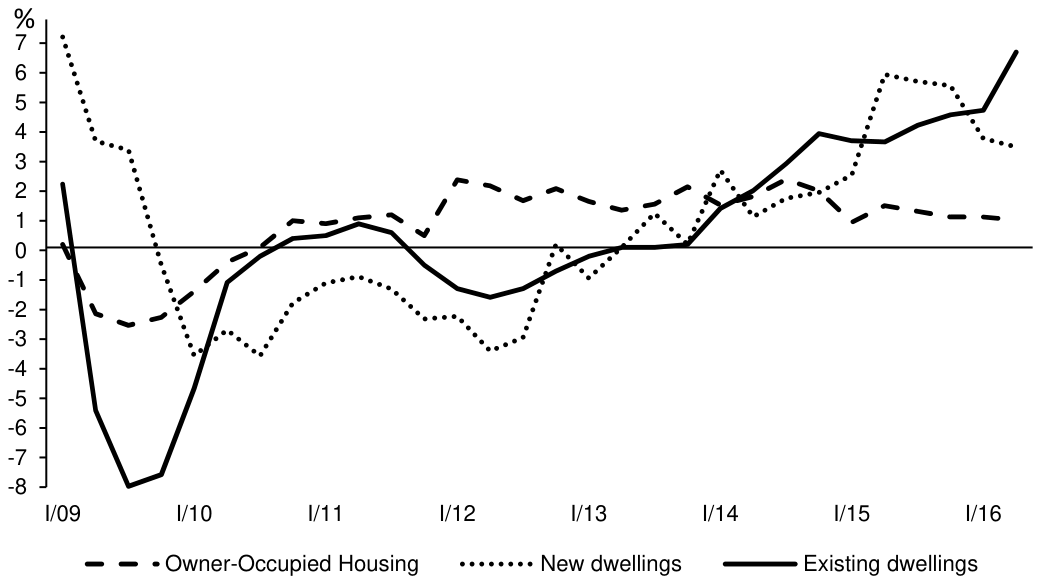
Figure 1 shows that the index of owner-occupied housing for the Czech Republic (computed according to the Eurostat definition, which is nevertheless very close to the current definition of the Czech Statistical Office) does not display much cyclical variation and is only mildly correlated with house prices. The index includes prices of dwellings new to the household sector, but only with a small weight; it excludes prices of dwellings sold from one household to another, which is how most transactions in the housing market take place (in the Czech Republic it is 90% according to the Eurostat). We can also see that prices of new dwellings show considerably less variation than prices of existing dwellings: the index of new dwellings did not capture, for example, the large decrease in house prices on the secondary market in 2009. Prices of existing dwellings provide a better early-warning signal (see Section 2), because individual households are more sensitive to changes in sentiment than developers, who are more likely to be able to wait and see before selling.
Source: Czech Statistical Office.
| COICOP | Title | Weight in CPI | Weight in CPIH |
|---|---|---|---|
| 01. | Food and non-alcoholic beverages | 18.1% | 15.5% |
| 02. | Alcoholic beverages and tobacco | 9.3% | 8.0% |
| 03. | Clothing and footwear | 3.9% | 3.4% |
| 04.1 | Actual rentals for housing | 3.5% | 3.0% |
| 04.2 | Owner-occupied housing (including new dwellings) | 8.7% | 7.5% |
| 04.x | Existing dwellings | 0.0% | 14.0% |
| 04.y | Other expenses on housing, water, electricity, gas and other fuels | 12.9% | 11.1% |
| 05. | Furnishings, household equipment and routine maintenance | 5.8% | 5.0% |
| 06. | Health | 2.3% | 2.0% |
| 07. | Transport | 10.1% | 8.7% |
| 08. | Communication | 3.1% | 2.6% |
| 09. | Recreation and culture | 9.0% | 7.7% |
| 10. | Education | 0.6% | 0.5% |
| 11. | Restaurants and hotels | 5.8% | 5.0% |
| 12. | Miscellaneous goods and services | 6.9% | 6.0% |
Note: The first column denotes the number of the corresponding item in the Classification of Individual Consumption According to Purpose (COICOP). Since existing dwellings are typically not included in COICOP, we label them 04.x (04 denoting the housing category). The next item, 04.y, denotes all remaining items in category 04. Source: Czech Statistical Office; Czech National Bank. CPIH = CPI including prices of existing dwellings.
For these reasons we believe there is merit in giving non-zero weight to prices of existing dwellings. In the first half of 2016, the Czech National Bank started to compute for its internal purposes an experimental index of broader inflation, CPIH, including house prices along with the traditionally defined owner-occupied housing. The weight of existing dwellings was set to 14%, which is a significant share (especially in comparison with owner-occupied housing based on the net acquisitions approach), but still smaller than the weight used in the US CPI prior to 1983. The weight is determined by the share of consumer expenditure on existing dwellings and is consistent with the way the weights for the other components of CPI are computed. Weights for individual categories in Czech CPI and CPIH are shown in Table 4. An important issue that we do not tackle are the regional differences in the development in house prices, which may have important macroprudential implications. Nevertheless, regional heterogeneity is not a problem specific to house prices, as the development of individual components of CPI differ across regions too.
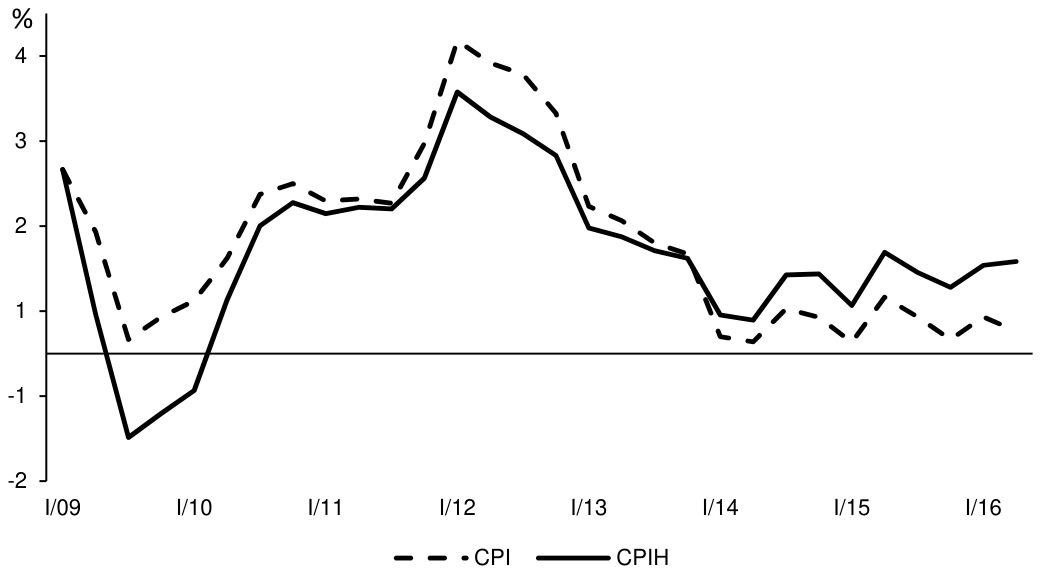
Figure 2 shows that the broader inflation measure would call for significantly more expansionary monetary policy in 2009, 2010, and 2012,2 but somewhat tighter monetary conditions in 2015 and 2016 – although in the latter case even broader inflation was safely below the Czech National Bank’s target of 2%. While the difference between the CPI and the CPIH is substantial, it is not dramatic, and CPIH targeting would not radically redefine the conduct of Czech monetary policy. If anything, it would make it more aggressively countercyclical.
Source: Czech Statistical Office; Czech National Bank. CPIH = CPI including prices of existing dwellings.
6. Concluding Remarks
We do not argue, however, that the time has come to replace the current inflation measures with broader indices that fully incorporate house prices. Rather, we consider such broader measures of inflation to be useful supplementary indicators, similar in this function to core inflation, which, in contrast, constitutes a narrower gauge than headline CPI inflation. The assessment of Goodhart (2001, p. F338) resonates with our thoughts on the matter: “Continuity, certainty, and simplicity all argue against chopping and changing existing procedures. So in the conclusions, we do not argue for replacing the present measures, but of paying rather more attention to accompanying, alternative measures which do give a more appropriate weighting to asset prices.” A major technical limitation of the broader index is that, at present, reliable data on house prices are available only at quarterly frequency and with a significant lag. Moreover, several alternative measures of house prices exist in the Czech Republic (see, for example, Hlaváček and Komárek, 2011); each has its pros and cons. The internationally comparable data that we use are subject to subsequent revisions, which imposes further practical problems and somewhat reduces the usability of the broader index.
Consequently, the Czech National Bank has not dropped its focus on headline CPI inflation in favor of a broader measure that captures more fully house prices, and does not plan to do so in the foreseeable future. But the broader measure, the CPIH, has become one of the important indicators that the Czech National Bank’s Board considers when it decides on changes in the monetary policy stance. In a well-known and colorfully titled paper “Measuring Inflation: The Core Is Rotten,” the president of the Federal Reserve Bank of St. Louis, James Bullard, criticizes the Federal Reserve’s focus on core inflation and argues for paying more attention to a broader gauge of inflation. To paraphrase Bullard’s (2011, p. 223) provocative statement, we can say the following: One immediate benefit of dropping the sole emphasis on an inflation measure that excludes house purchases would be to reconnect central banks and statistical bureaus with households and businesses who know price changes when they see them.
REFERENCES
- Alchian, A. and B. Klein (1973): “On a Correct Measure of Inflation.” Journal of Money, Credit and Banking, vol. 5(1), pp. 173-191.
- Antunes, A., D. Bonfim, N. Monteiro, and P. Rodrigues (2014): “Early Warning Indicators of Banking Crises: Exploring New Data and Tools.” Economic Bulletin and Financial Stability Report Articles, Economics and Research Department, Banco de Portugal.
- Assenmacher-Wesche, K. and S. Gerlach (2010): “Monetary Policy and Financial Imbalances: Facts and Fiction.” Economic Policy, vol. 25, pp. 437-482.
- Aydin, B. and E. Volkan (2011): “Incorporating Financial Stability in Inflation Targeting Frameworks.” IMF Working Papers 11/224, International Monetary Fund.
- Babecký, J., T. Havránek, J. Matějů, M. Rusnák, K. Šmídková, and B. Vašíček (2011): “Early Warning Indicators of Economic Crises: Evidence from a Panel of 40 Developed Countries,” CNB WP 8/2011.
- Babecký, J., T. Havránek, J. Matějů, M. Rusnák, K. Šmídková, and B. Vašíček (2013): “Leading Indicators of Crisis Incidence: Evidence from Developed Countries.” Journal of International Money and Finance, vol. 35(C), pp. 1-19.
- Boldsen, C. (2011): UNECE Workshop on Consumer Price Indices. Istanbul, Turkey, October 10-13, 2011.
- Bryan, M., S. G. Cecchetti, and R. O’Sullivan (2002): “Asset Prices in the Measurement of Inflation.” NBER Working Paper 8700.
- Brůha, J., M. Hlaváček, and L. Komárek (2013): “Impacts of Housing Prices on the Financial Position of Households.” Chapters in Edited Volumes, in: CNB Financial Stability Report 2012/2013.
- Brůha J. and J. Polanský (2014): “The Housing Sector over Business Cycles: Empirical Analysis and DSGE Modelling.” CNB WP 12/2014.
- Brůha, J. and J. Tonner (2017): “The Exchange Rate Floor as an Instrument of Monetary Policy: An Ex-Post Assessment of the Czech Experience.” CNB working paper, forthcoming.
- Bullard, J. B. (2011): “Measuring Inflation: The Core Is Rotten.” Federal Reserve Bank of St. Louis Review, July, pp. 223-234.
- Czech Statistical Office (2016): “Consumer Price Indices: User’s Methodological Manual.” Technical report.
- Diewert, W. E. and A. O. Nakamura (2009): “Accounting for Housing in a CPI.” Working Papers 09-4, Federal Reserve Bank of Philadelphia.
- ECB (2016): “ECB Estimates of the Impact of Including Owner-Occupied Housing Price Indices into the Headline HICP.” Technical report, July 29, 2016.
- Eurostat (2012): “Detailed Technical Manual on Owner-Occupied Housing for Harmonized Index of Consumer Prices.” Technical report, March 2012.
- Eurostat (2013): “Methodological Manual Referred to in Commission Regulation (EU) No 93/2013.” Technical report, February 2013.
- Frait, J. and Z. Komárková (2012): “Macroprudential Policy and Its Instruments in a Small EU Economy.” CNB Research and Policy Note 3/2012.
- Gillingham, R. and W. Lane (1982): “Changing the Treatment of Shelter Costs for Homeowners in the CPI.” Monthly Labor Review, June, pp. 9-14.
- Goodhart, C. (2001): “What Weight Should Be Given to Asset Prices in the Measurement of Inflation?” Economic Journal, Royal Economic Society, vol. 111(472), pp. F335-356.
- Hejlová, H., M. Hlaváček, and L. Komárek (2017): “A Comprehensive Method for House Price Sustainability Assessment in the Czech Republic.” Prague Economic Papers, vol. 26(3), pp. 269-285.
- Hlaváček, M. and L. Komárek (2009): “Housing Price Bubbles and their Determinants in the Czech Republic and its Regions.” CNB WP 12/2009.
- Hlaváček, M. and L. Komárek (2011): “Regional Analysis of Housing Price Bubbles and Their Determinants in the Czech Republic.” Czech Journal of Economics and Finance, vol. 61(1), pp. 67-91.
- Jansson, P. (2015): “Time to Improve the Inflation Target?” Speech by Mr. Per Jansson, Deputy Governor of the Sveriges Riksbank, at Handelsbanken, Stockholm, December 3, 2015.
- Johansson, J. (2015): “How Is Inflation Measured?” Economic Commentaries, no. 5/2015, Sveriges Riksbank.
- Kindleberger, C. and R. Aliber (2015): “Manias, Panics, and Crashes: A History of Financial Crises.” Seventh edition, Palgrave Macmillan.
- Laina, P., J. Nyholm, and P. Sarlin (2015): “Leading Indicators of Systemic Banking Crises: Finland in a Panel of EU Countries.” Working Paper Series 1758, European Central Bank.
- Malovaná, S. and J. Frait (2016): “Monetary Policy and Macroprudential Policy: Rivals or Teammates?” CNB WP 6/2016.
- McCarthy, J., R. Peach, and M. Ploenzke (2015): “The Measurement of Rent Inflation.” Staff Reports 425, Federal Reserve Bank of New York, revised December 1, 2015.
- OECD (2015a): Methodological Notes for OECD CPI News Release. www.oecd.org/std/prices-ppp/47010757.pdf.
- OECD (2015b): Methodological Notes for Compilation of G20 Consumer Price Index. http://www.oecd.org/std/prices-ppp/CPI-G20-methodology.pdf.
- Opatrný, M. (2016): “Quantifying the Effects of the CNB’s Exchange Rate Commitment: A Synthetic Control Method.” IES WP 17/2016, Charles University, Prague.
- Reimers, H. (2012): “Early Warning Indicator Model of Financial Developments Using an Ordered Logit.” Business and Economic Research, Macrothink Institute, vol. 2(2), pp. 171-191.
- Reinhart, C. and K. Rogoff (2009): “This Time Is Different: Eight Centuries of Financial Folly.” Princeton University Press.
- Reis, R. (2005): “A Dynamic Measure of Inflation.” NBER Working Paper 11746.
- Rusnák, M., T. Havránek, and R. Horváth (2013): “How to Solve the Price Puzzle? A Meta-Analysis.” Journal of Money, Credit and Banking, vol. 45(1), pp. 37-70.
- Svensson, L. (2014): “Inflation Targeting and Leaning against the Wind.” International Journal of Central Banking, vol. 10(2), pp. 103-114.
- Tölö, E. (2015): “Early Warning Indicators of Banking Crises.” Bank of Finland Bulletin 2/2015.
- Tonner, J. and J. Brůha (2014): “The Czech Housing Market Through the Lens of a DSGE Model Containing Collateral-Constrained Households.” CNB WP 9/2014.
- Williams, J. C. (2015): “Measuring Monetary Policy’s Effect on House Prices.” FRBSF Economic Letter 2015-28, Federal Reserve Bank of San Francisco.
- Woolford, K. (2010): “An Exploration of Alternative Treatments of Owner-Occupied Housing in a CPI.” Technical Advisory Group Meeting, International Comparison Program.
- Žáček, J. (2016): “Should Monetary Policy Pay Attention to Financial Stability? A DSGE Approach.” Master’s thesis, Institute of Economic Studies, Charles University, Prague.
ENDNOTES
- Furthermore, some authors (e.g., Tonner and Brůha, 2014) argue that, instead of actual house prices, deviations from equilibrium values should be used in policy rules of central banks. Equilibrium values of house prices are often significantly affected by government policy. Another issue is that the transmission lag of monetary policy may differ systematically between house prices and other prices included in the CPI.
- In 2012 the Czech National Bank reached the zero lower bound on the policy rate, and in 2013, as a means of additional monetary easing, it committed to keep the Czech koruna from appreciating beyond CZK 27 per euro (the commitment was terminated on April 6, 2017). The exchange rate commitment has benefited the Czech economy significantly (Brůha and Tonner, 2017; Opatrný, 2016). Had the Czech National Bank targeted the CPIH instead of the CPI, the commitment would probably have been introduced and terminated earlier.