Abstract
Energy planners have long assumed that electricity demand will grow more price-responsive as metering, automation, and storage spread, an assumption now embedded in decarbonization plans. We test it against the empirical record: 4,720 own-price elasticity estimates from 462 studies, with data spanning 1934–2024, ranked on a single ladder of identification quality from naive regressions to randomized experiments. Three findings emerge. First, the best-identified studies find smaller responses than naive ones: the publication-bias-corrected short-run elasticity is about −0.16 (a 10% rise in the electricity price cuts consumption by under 2%), and only −0.09 among the best-identified studies, whose adjusted value is statistically indistinguishable from zero. Second, responsiveness grows with time to adjust, roughly doubling from −0.16 in the short run to −0.38 in the long run as the capital stock turns over, but this pattern has itself been stable for decades. Third, and most important, responsiveness shows no upward trend across nine decades of data; if anything, the most technology-rich settings, including time-of-use pricing, are the least price-responsive in total consumption. Prices alone have not made total electricity consumption more responsive; broader demand flexibility will have to be engineered and paid for, through enabling technology, contracts, and program design.
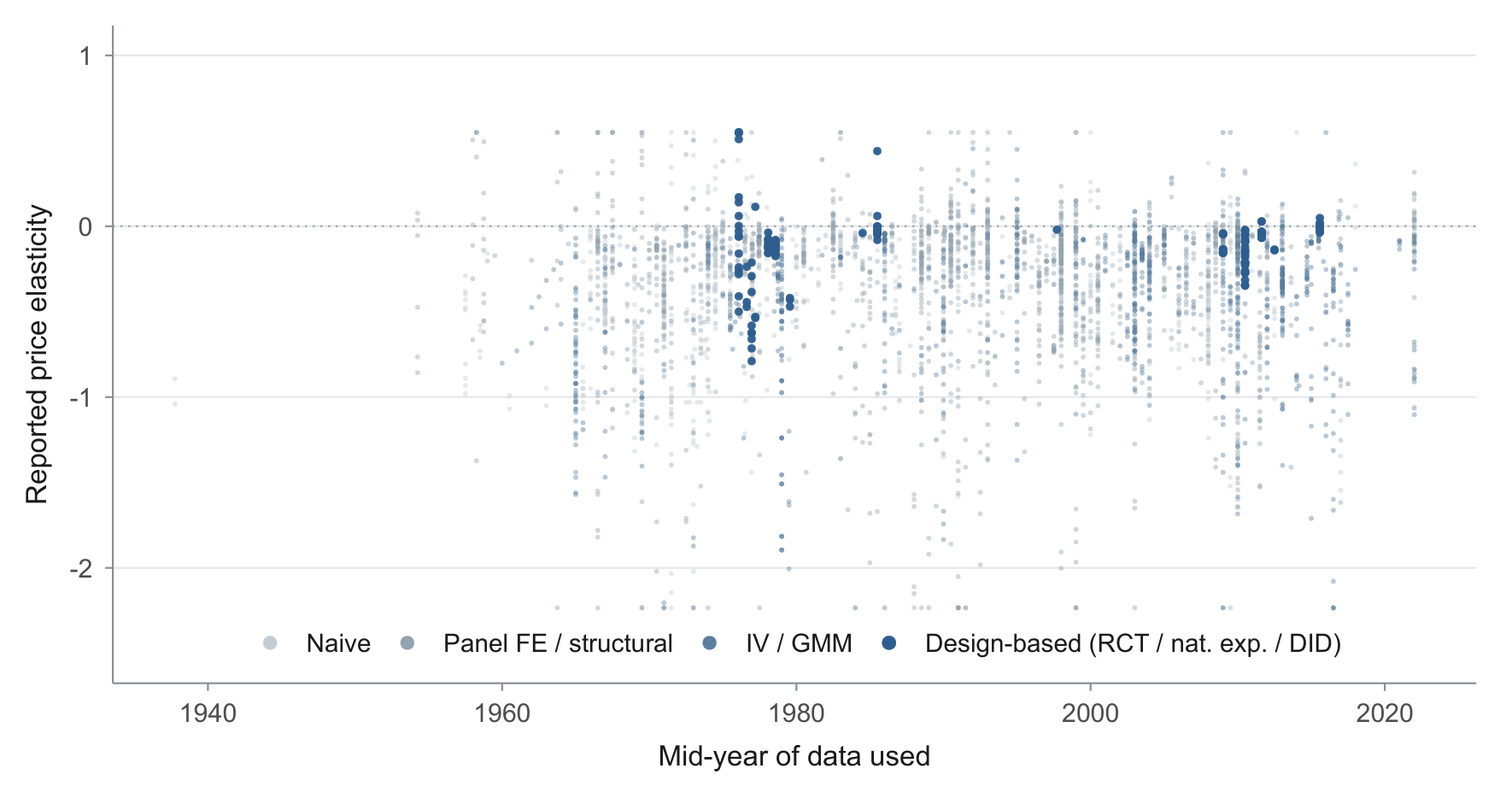
Reported own-price elasticities against the mid-year of the underlying data, coloured by identification tier; the 3,843 tier-classified estimates with usable standard errors are shown, the vertical axis truncated so that 44 outlying estimates fall outside the frame. Those outliers are omitted from the figure only and kept in every analysis, as are the unclassified estimates in the non-ladder analyses. Two features organize the paper: the raw record shows no visible drift over nine decades, and the design-based literature (dark blue) arrives late and thin, so composition must be held fixed before any trend is read as behaviour.
Materials: paper, online appendix, replication package, dataset, and the list of the 462 studies.
Reference: Peter Kudela, Tomas Havranek, Zuzana Irsova, Anna Kudelova, Vojtech Sikl (2026), “Electricity demand has not become more price-responsive despite ninety years of technological change.” Charles University, Prague. Available at meta-analysis.cz/electricity.
Headline result
Price elasticity of electricity demand: corrected for publication bias, -0.16 short run, -0.38 long run (best-identified short-run estimates statistically indistinguishable from zero), based on 4,720 estimates from 462 studies (Kudela et al. 2026).
How to cite
Peter Kudela, Tomas Havranek, Zuzana Irsova, Anna Kudelova, Vojtech Sikl (2026), “Electricity demand has not become more price-responsive despite ninety years of technological change.” Charles University, Prague. Available at meta-analysis.cz/electricity.
BibTeX
@misc{kudela2026electricity,
  author  = {Peter Kudela and Tomas Havranek and Zuzana Irsova and Anna Kudelova and Vojtech Sikl},
  title   = {Electricity demand has not become more price-responsive despite ninety years of technological change},
  year    = {2026},
}